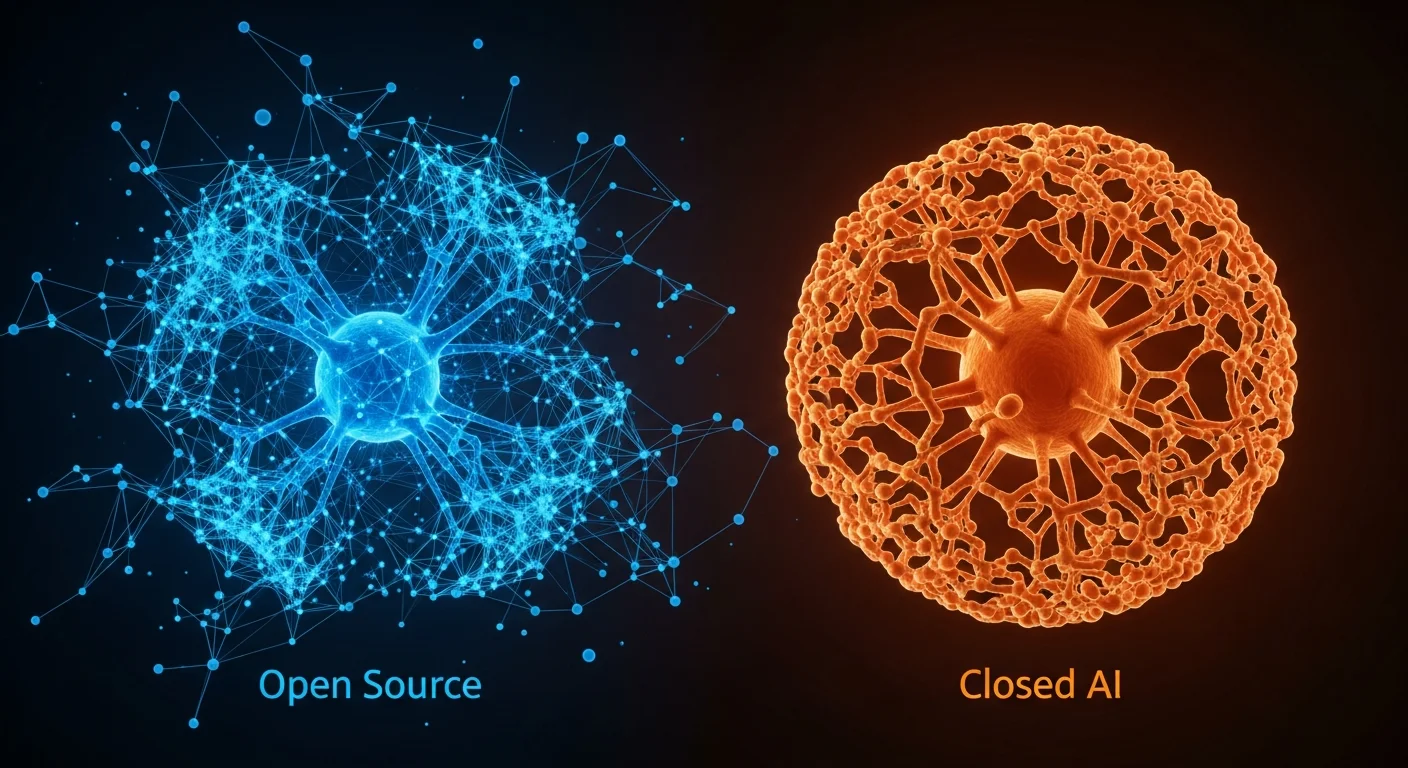
- 1.Closed LLMs like GPT-4 and Claude lead in performance but cost $0.03-0.12 per 1K tokens vs $0.0002-0.004 for self-hosted open models
- 2.Open source models (Llama 3.1, Mistral) offer full control and customization but require significant infrastructure expertise
- 3.Privacy-sensitive applications favor open source due to data control, while rapid prototyping benefits from closed API simplicity
- 4.Performance gap narrowing: Llama 3.1 405B matches GPT-4 on many benchmarks while being freely available for commercial use
| Factor | Open Source LLMs | Closed LLMs |
|---|---|---|
| Top Models | Llama 3.1 405B, Mistral Large 2 | GPT-4o, Claude 3.5 Sonnet |
| Licensing | Free commercial use (most) | Pay-per-use API |
| Data Privacy | Full control, on-premises | Data sent to provider |
| Customization | Full model fine-tuning | Limited prompt engineering |
| Setup Complexity | High (infrastructure required) | Low (API call) |
| Inference Cost | $0.0002-0.004/1K tokens | $0.03-0.12/1K tokens |
| Performance | Competitive (top models) | Leading edge |
| Latency | Variable (depends on setup) | Optimized, consistent |
Source: Compiled from provider documentation and benchmarks, December 2024
Source: Based on AWS pricing calculations
Open Source LLMs: Complete Technical Analysis
Open source large language models have evolved from research experiments to production-ready alternatives. Meta's Llama 3.1 405B now matches GPT-4 performance on many benchmarks, while Mistral's models offer excellent efficiency. The key advantage: complete control over your AI infrastructure.
Leading open source models in 2025 include Llama 3.1 (8B, 70B, 405B), Mistral Large 2, Qwen 2.5, and specialized variants like Code Llama for programming tasks. These models can be downloaded, modified, and deployed on your own infrastructure without ongoing licensing fees.
- Full Model Access: Download weights, inspect architecture, modify as needed
- Zero Runtime Licensing: No per-token charges after initial hardware investment
- Data Sovereignty: Process sensitive data entirely on-premises
- Custom Fine-tuning: Adapt models to specific domains or tasks
- Transparent Operations: No black box limitations or usage restrictions
The trade-off is complexity. Running a 70B parameter model efficiently requires expertise in GPU clustering, quantization techniques, and inference optimization. Most organizations need dedicated AI/ML engineers to manage deployment and scaling.
Open Source LLMs: Advantages & Challenges
- 95%+ cost reduction for high-volume inference
- Complete data privacy and on-premises processing
- Full customization through fine-tuning and architectural changes
- No vendor lock-in or API dependencies
- Transparent model behavior and capabilities
- Community-driven improvements and specialized variants
- Requires significant GPU infrastructure (8x A100s for 70B models)
- Complex deployment and optimization expertise needed
- Performance gaps still exist for most advanced reasoning tasks
- No built-in safety filters or content moderation
- Infrastructure scaling and management overhead
- Slower access to latest model improvements
Closed LLMs: Complete Technical Analysis
Closed-source LLMs like GPT-4o, Claude 3.5 Sonnet, and Gemini Pro represent the advanced of AI capability. These models are accessed exclusively through APIs, with the underlying architecture and training data kept proprietary by their creators.
The primary advantage is performance: closed models consistently lead benchmarks for reasoning, coding, and complex tasks. OpenAI's GPT-4o achieves 88.4% on MMLU, while Claude 3.5 Sonnet excels at code generation. These models also include built-in safety measures and content filtering.
- State-of-the-Art Performance: Leading benchmarks across multiple domains
- Zero Infrastructure: Simple API integration, no hardware requirements
- Built-in Safety: Content moderation and alignment built-in
- Continuous Updates: Automatic access to model improvements
- Optimized Latency: Professional-grade inference infrastructure
- Enterprise Features: Usage analytics, fine-tuning APIs, dedicated throughput
The cost structure is pay-per-use, $0.03-0.12 per 1,000 tokens depending on model size and provider. For AI applications with high token volume, this can become expensive quickly, a single GPT-4 conversation might cost $0.50-2.00.
Closed LLMs: Advantages & Challenges
- Superior performance on complex reasoning and coding tasks
- Zero infrastructure investment or maintenance
- Built-in safety measures and content moderation
- Rapid prototyping and development speed
- Enterprise-grade reliability and uptime
- Continuous model improvements without migration
- High costs for production workloads ($0.03-0.12/1K tokens)
- No data privacy guarantees (processed on provider servers)
- Limited customization beyond prompt engineering
- Vendor lock-in and dependency risks
- Rate limiting and usage restrictions
- Black box behavior with no transparency
| Parameters | |||||
|---|---|---|---|---|---|
| GPT-4o | Closed | 8840% | 9020% | 9580% | Unknown |
| Claude 3.5 Sonnet | Closed | 8870% | 9200% | 9640% | Unknown |
| Llama 3.1 405B | Open | 8860% | 8900% | 9680% | 405B |
| Llama 3.1 70B | Open | 8360% | 8050% | 9510% | 70B |
| Mistral Large 2 | Open | 8400% | 8500% | 9120% | 123B |
| Gemini 1.5 Pro | Closed | 8590% | 8470% | 9170% | Unknown |
Cost Analysis: TCO Breakdown by Usage Volume
Cost considerations vary based on usage patterns. For low-volume applications (under 1M tokens/month), closed APIs are more cost-effective when factoring in infrastructure and engineering costs. High-volume applications see massive savings with self-hosted open models.
A typical self-hosted Llama 70B setup requires 8x A100 GPUs (roughly $80,000 in cloud costs annually) plus engineering overhead. This breaks even against GPT-4 API costs at approximately 20-30 million tokens per month, depending on your engineering team's efficiency.
| Usage Scenario | Recommended | |||
|---|---|---|---|---|
| Small App/Prototype | 100,000 | $3,000 | $8,000 | Closed API |
| Medium SaaS | 5,000,000 | $150,000 | $12,000 | Open Source |
| Enterprise Chatbot | 50,000,000 | $1,500,000 | $15,000 | Open Source |
| AI-First Product | 500,000,000 | $15,000,000 | $25,000 | Open Source |
Technical Implementation: Deployment Considerations
Deploying open source LLMs requires expertise in distributed systems, GPU optimization, and inference frameworks. Popular deployment stacks include vLLM, TensorRT-LLM, and Text Generation Inference (TGI), each optimized for different use cases.
# Example: Deploying Llama 3.1 70B with vLLM
from vllm import LLM, SamplingParams

# Initialize model (requires ~140GB GPU memory)
llm = LLM(
    model="meta-llama/Meta-Llama-3.1-70B-Instruct",
    tensor_parallel_size=8,  # 8 GPUs
    dtype="float16",
    max_model_len=8192
)

# Generate response
sampling_params = SamplingParams(temperature=0.7, max_tokens=512)
response = llm.generate(["Explain quantum computing"], sampling_params)
print(response[0].outputs[0].text)
Closed APIs require minimal setup but less control. Most providers offer SDKs for popular languages, with standardized OpenAI-compatible endpoints becoming the norm across providers.
# Example: Using OpenAI API (works with GPT-4, Claude via proxy)
import openai

client = openai.OpenAI(api_key="your-key")

response = client.chat.completions.create(
    model="gpt-4o",
    messages=[
        {"role": "user", "content": "Explain quantum computing"}
    ],
    max_tokens=512,
    temperature=0.7
)

print(response.choices[0].message.content)Which LLM Approach Should You Choose?
- Processing sensitive data that can't leave your infrastructure
- High-volume usage (20M+ tokens/month) where costs matter
- Need custom fine-tuning for domain-specific tasks
- Building AI-first products where model control is critical
- Have experienced ML infrastructure team
- Want to avoid vendor lock-in and dependencies
- Rapid prototyping and getting to market quickly
- Low to medium usage volumes (under 10M tokens/month)
- Limited ML infrastructure expertise on team
- Need advanced performance for complex reasoning
- Want built-in safety and content moderation
- Prefer predictable API costs over infrastructure management
- Different use cases have varying performance/cost requirements
- Want to hedge against vendor dependency while maintaining performance
- Can route simple tasks to open models, complex ones to closed APIs
- Building gradually from prototype (closed) to production scale (open)
Open Source vs Closed LLMs FAQ
Related AI & Technical Guides
AI Education & Career Resources
Sources & Further Reading
Open source model repository and benchmarks
GPT-4 and ChatGPT API reference
Claude API and model capabilities
Llama model papers and benchmarks
High-performance inference server

Taylor Rupe
Co-founder & Editor (B.S. Computer Science, Oregon State • B.A. Psychology, University of Washington)
Taylor combines technical expertise in computer science with a deep understanding of human behavior and learning. His dual background drives Hakia's mission: leveraging technology to build authoritative educational resources that help people make better decisions about their academic and career paths.