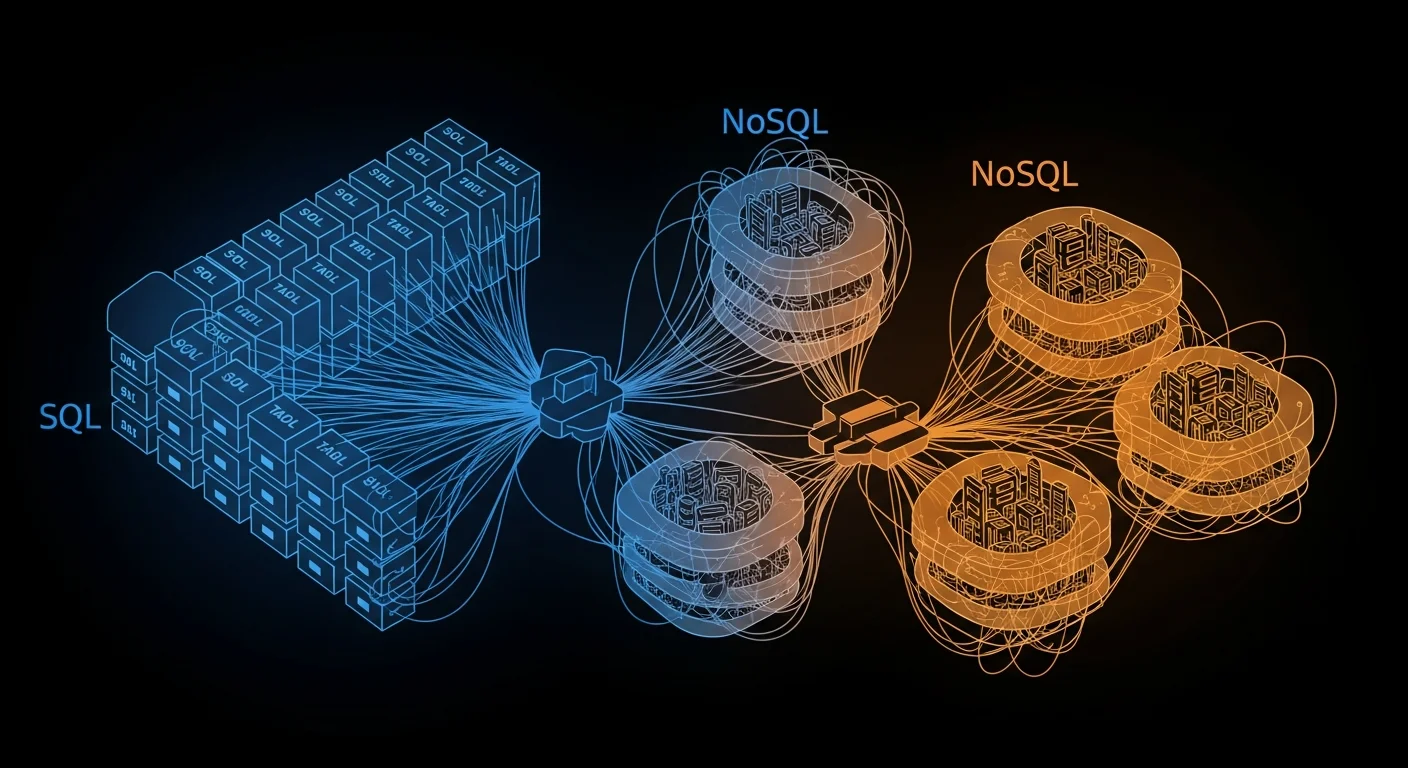
- 1.SQL databases (PostgreSQL, MySQL) excel at ACID transactions but scale vertically. 72% of developers still use them daily
- 2.NoSQL databases (MongoDB, Cassandra) provide horizontal scaling and flexibility but sacrifice consistency guarantees
- 3.NewSQL systems (CockroachDB, TiDB) attempt to combine SQL semantics with NoSQL scalability, though with complexity trade-offs
- 4.Choice depends on your consistency requirements, scale needs, and team expertise, not just performance benchmarks
| Criteria | SQL | NoSQL | NewSQL |
|---|---|---|---|
| ACID Compliance | Full ACID | Eventual consistency | Full ACID |
| Horizontal Scaling | Limited | Excellent | Good |
| Schema Flexibility | Rigid schema | Schema-free | Flexible schema |
| Query Language | SQL (standardized) | Various APIs | SQL-compatible |
| Consistency | Strong | Eventual | Strong |
| Performance (OLTP) | Good | Excellent | Good |
| Maturity | 40+ years | 15+ years | 5+ years |
| Learning Curve | Familiar | Moderate | Complex |
Source: Stack Overflow 2024 Survey
SQL Databases: The Foundation of Data Management
SQL (Structured Query Language) databases have dominated enterprise data management for over four decades. Built on the relational model, they provide strong consistency guarantees through ACID transactions (Atomicity, Consistency, Isolation, Durability) and use a standardized query language understood by millions of developers worldwide.
Modern SQL databases like PostgreSQL and MySQL have evolved significantly, adding JSON support, horizontal scaling features, and cloud-native capabilities. Despite the NoSQL revolution, SQL databases remain the go-to choice for applications requiring strict data consistency and complex relational queries.
- ACID Compliance: Guarantees data consistency even during system failures
- Mature Ecosystem: Decades of tooling, optimization, and expertise
- Standardized Query Language: SQL skills transfer across all relational databases
- Strong Consistency: Immediate consistency for all read operations
- Complex Queries: JOINs, aggregations, and analytical queries are native
SQL Databases: Advantages & Limitations
- Your application requires ACID transactions
- Data relationships are complex and well-defined
- You need strong consistency guarantees
- Your team is familiar with SQL
- Compliance and audit requirements are strict
- Data integrity is more important than raw performance
- Vertical scaling becomes expensive at large scale
- Schema changes require careful migration planning
- Object-relational impedance mismatch with modern apps
- Limited horizontal partitioning capabilities
- Performance degrades with very large datasets
NoSQL Databases: Built for Scale and Flexibility
NoSQL databases emerged to address the scalability and flexibility limitations of traditional SQL systems. Unlike relational databases, NoSQL systems are designed for horizontal scaling across distributed clusters and often sacrifice consistency for availability and partition tolerance (following the CAP theorem).
The NoSQL umbrella includes four main categories: document stores (MongoDB, CouchDB), key-value stores (Redis, DynamoDB), column-family (Cassandra, HBase), and graph databases (Neo4j, Amazon Neptune). Each category optimizes for specific use cases and data access patterns.
- Horizontal Scaling: Add nodes to increase capacity linearly
- Schema Flexibility: Store semi-structured or unstructured data
- High Performance: Optimized for specific access patterns
- Eventual Consistency: Better availability but delayed consistency
- Modern APIs: REST, JSON, and language-specific drivers
Store data as documents (usually JSON/BSON) with nested structures and flexible schemas
Key Skills
Common Jobs
- • Full-stack developers
- • Mobile app backends
- • Content management systems
Simple key-value pairs optimized for high-speed lookups and caching
Key Skills
Common Jobs
- • Session storage
- • Caching layers
- • Real-time applications
Store data in column families for efficient analytics and time-series data
Key Skills
Common Jobs
- • IoT data
- • Time-series analytics
- • Log storage
Optimize for relationships and connections between data entities
Key Skills
Common Jobs
- • Social networks
- • Recommendation engines
- • Fraud detection
NoSQL Databases: Advantages & Limitations
- You need to scale horizontally across multiple servers
- Data structure is flexible or rapidly changing
- High throughput and low latency are critical
- Working with unstructured or semi-structured data
- Geographic distribution requires eventual consistency
- Agile development needs schema flexibility
- No ACID guarantees can lead to data inconsistency
- Learning curve for developers familiar with SQL
- Limited support for complex queries and joins
- Eventual consistency can cause application complexity
- Less mature tooling and monitoring compared to SQL
NewSQL Databases: The Best of Both Worlds?
NewSQL databases attempt to bridge the gap between SQL and NoSQL by providing ACID transactions and SQL compatibility while offering the horizontal scalability of NoSQL systems. Systems like CockroachDB, TiDB, and Google Spanner represent this new generation of distributed SQL databases.
The key innovation in NewSQL systems is their ability to maintain ACID properties across distributed clusters using advanced consensus algorithms like Raft. This allows applications to benefit from familiar SQL semantics while scaling beyond the limits of traditional relational databases.
- Distributed ACID: Full ACID compliance across multiple nodes
- SQL Compatibility: Use existing SQL knowledge and tools
- Horizontal Scaling: Add nodes to increase capacity
- Strong Consistency: Consistent reads across all nodes
- Cloud-Native: Built for containerized, cloud deployments
NewSQL Databases: Advantages & Limitations
- You need SQL semantics with horizontal scaling
- ACID transactions are required at scale
- Complex queries and joins are essential
- Strong consistency is non-negotiable
- You want to modernize legacy SQL applications
- Geographic distribution with consistency is needed
- Higher complexity than traditional SQL or NoSQL
- Performance overhead from distributed consensus
- Newer technology with smaller ecosystem
- Higher operational complexity and costs
- May not match specialized NoSQL performance
Database Performance Comparison
| Simple Reads (ops/sec) | 15,000 | 25,000 | 12,000 |
| Simple Writes (ops/sec) | 8,000 | 18,000 | 6,000 |
| Complex Queries | Excellent | Limited | Good |
| Horizontal Scaling | Limited | Linear | Good |
| Consistency Guarantees | Strong | Eventual | Strong |
| Latency (P99) | 5ms | 2ms | 8ms |
Real-World Use Cases and Success Stories
Understanding when to use each database type becomes clearer through real-world examples. Major tech companies often use multiple database types within the same application, choosing the right tool for each specific use case.
SQL Success Stories: PayPal processes billions of transactions using PostgreSQL clusters. Stripe's payment processing relies heavily on MySQL for its ACID guarantees. These financial applications prioritize consistency over raw performance, making SQL the natural choice.
NoSQL Success Stories: Netflix uses Cassandra to store viewing history and recommendations for 230 million users. MongoDB powers the content management systems of Forbes and eBay. These applications benefit from schema flexibility and horizontal scaling.
NewSQL Success Stories: CockroachDB powers Lush's global e-commerce platform, providing ACID transactions across multiple regions. SpaceX uses CockroachDB for telemetry data that requires both consistency and global distribution.
Database Decision Framework: When to Use Which
- Financial applications requiring ACID transactions
- Complex reporting and analytics with JOINs
- Applications with well-defined, stable schemas
- Regulatory compliance requiring audit trails
- E-commerce platforms with inventory management
- Traditional enterprise applications
- High-scale web applications with simple queries
- Real-time analytics and time-series data
- Content management with flexible schemas
- Mobile and IoT applications requiring fast reads
- Social media platforms with user-generated content
- Caching layers and session storage
- Global applications requiring strong consistency
- Modernizing legacy SQL applications for scale
- Multi-region deployments with ACID requirements
- Applications that outgrew traditional SQL but need consistency
- Cloud-native applications requiring SQL semantics
- Hybrid transactional/analytical processing (HTAP)
Career Paths
Database Administrator
Manage and optimize database systems across SQL, NoSQL, and NewSQL platforms
Database Choice FAQ
Related Engineering Topics
Data Science and Analytics Programs
Database Skills and Certifications
Data Sources and References
Database usage statistics among developers
Popularity rankings of database management systems
Comparative performance analysis of database types
NoSQL adoption and use case analysis
Theoretical foundation for distributed database design

Taylor Rupe
Co-founder & Editor (B.S. Computer Science, Oregon State • B.A. Psychology, University of Washington)
Taylor combines technical expertise in computer science with a deep understanding of human behavior and learning. His dual background drives Hakia's mission: leveraging technology to build authoritative educational resources that help people make better decisions about their academic and career paths.