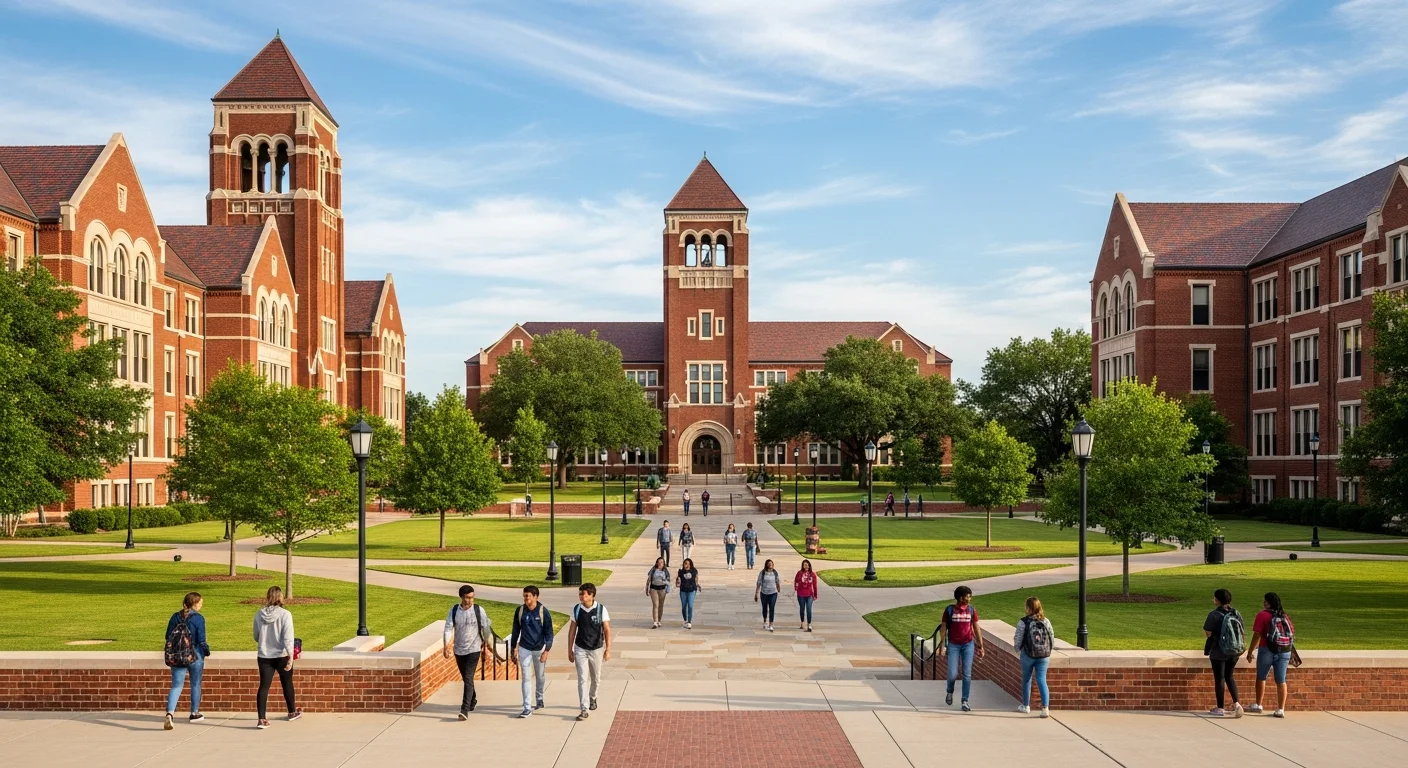
University campus in Oklahoma
Updated January 2026

Best Information Security Degree Programs in Oklahoma — 2026 Rankings

Compare the top information security colleges in Oklahoma. 5 accredited information security schools ranked by graduation rate, career outcomes, and value—from Oklahoma State University-Main Campus to Southern Nazarene University.

#1 ProgramSouthern Nazarene
Avg Salary$89,340
Tuition From$5,417/yr
Job Growth+22%

Key Takeaways

Best information security degree programs: Southern Nazarene, U of Tulsa, Oral Roberts

Ranked by graduation rates, program outcomes, and institutional quality

IPEDS 2023

Tuition ranges from $5,417 to $46,932/year

Oklahoma State offers the most affordable option at $5,417/yr

IPEDS 2023

Information Security degree programs available: 1 associate's, 2 master's in Oklahoma

From community college pathways to advanced research degrees

IPEDS 2023

Oklahoma community college transfer can save 40-60% on total degree costs

1 associate's programs provide transfer pathways to bachelor's degrees

Education Commission of the States

Major employers: Paycom, Devon Energy, ONEOK, Love's Travel Stops

Tech hubs in Oklahoma City and Tulsa

Hakia Research 2026

Information Security degree programs near 50+ cities across Oklahoma

Search by city to find programs within 200 miles of your location

IPEDS 2023

Updated February 2026

On This Page
$89,340
Are Information Security Degree Programs in Oklahoma Worth It?
Yes. The best information security degree programs in Oklahoma deliver strong ROI—graduates earn $89,340 median salary with +22% job growth through 2032. In-state tuition averages $26,261/year.

Source: BLS OEWS May 2024

Best Information Security Bachelor's Programs in Oklahoma, 2026

4
Programs
$89,340
Median Salary
$31,472/yr
Avg Tuition
76%
Avg Grad Rate

Rankings based on program completions, graduation rates, selectivity, and career outcomes. See our methodology

Program Landscape

Oklahoma ranks among the nation's top destinations for information security education, with 4 accredited bachelor's degree programs across 0 public and 4 private institutions. The highest-ranked programs are Southern Nazarene, U of Tulsa, Oral Roberts, recognized for academic excellence, research opportunities, and strong industry connections.

Career Outcomes

Graduates from Oklahoma information security programs earn a median salary of $75,939—23% below the national average. The state's robust technology sector, anchored by the Oklahoma City, Tulsa, Norman metropolitan areas, provides abundant internship and employment opportunities with companies including Paycom, Devon Energy, ONEOK.

Costs & Value

Tuition ranges from $18,456 to $46,932 annually, with an average of $31,472/yr. Top programs maintain graduation rates above 76%, with the highest reaching 96%. Many programs hold ABET accreditation, the gold standard for computing education, ensuring curriculum meets rigorous industry standards.

Curriculum & Specializations

Students can choose from specializations including software engineering, cybersecurity, artificial intelligence, data science, and systems architecture. Strong industry partnerships provide access to co-op programs, capstone projects with real companies, and direct recruiting pipelines to Oklahoma's leading technology employers. For students seeking information security degrees in Oklahoma, these top-ranked information security schools offer the strongest combination of academic rigor and career preparation.

Earn your bachelor's in Information Security

(Sponsored)

Loading programs...

🥇

Southern Nazarene University

Private
Bethany, OK
$28,000
Tuition/yr
$933
Per Credit
81%
Grad Rate
62.5
Score
Website
🥈

University of Tulsa

PrivateNSA CAE
Tulsa, OK
$46,932
Tuition/yr
$1,564
Per Credit
51.4
Score
Website
🥉

Oral Roberts University

Private
Tulsa, OK
$32,500
Tuition/yr
$1,342
Per Credit
96%
Grad Rate
44.9
Score
Website
#4

Mid-America Christian University

Private
Oklahoma City, OK
$18,456
Tuition/yr
$769
Per Credit
51%
Grad Rate
45.5
Score
Website

Best Information Security Master's Programs in Oklahoma, 2026

2
Programs
$89,340
Median Salary
$26,175/yr
Avg Tuition
83%
Avg Grad Rate

Rankings based on program completions, graduation rates, selectivity, and career outcomes. See our methodology

Program Landscape

Oklahoma offers 2 master's degree programs in information security, designed for professionals seeking to advance into senior engineering, technical leadership, and specialized roles. The top programs—U of Tulsa, Oklahoma State—combine advanced technical training with research opportunities and leadership development.

Career Outcomes

Master's graduates in Oklahoma earn a median salary of $89,340, approximately 20-30% higher than bachelor's degree holders. The concentration of technology companies in Oklahoma City, Tulsa, Norman creates strong demand for graduate-level talent, with Paycom, Devon Energy, ONEOK actively recruiting from these programs.

Costs & Value

Program formats include traditional full-time study (typically 2 years), part-time options for working professionals (2-3 years), and accelerated tracks. Tuition averages $26,175/yr, with many employers offering tuition reimbursement for graduate education. Some programs offer thesis and non-thesis tracks, allowing students to focus on research or professional development based on their career goals.

Curriculum & Specializations

Curriculum covers advanced topics including machine learning, distributed systems, software architecture, and technical management. Many programs include practicum experiences, industry capstone projects, or consulting engagements that provide real-world application of advanced concepts. Among Oklahoma's information security schools at the graduate level, these programs stand out for both academic quality and career outcomes.

Advance your career with a Information Security master's degree

(Sponsored)

Loading programs...

🥇

University of Tulsa

PrivateNSA CAE
Tulsa, OK
$46,932
Tuition/yr
$1,564
Per Credit
68.2
Score
Website
🥈

Oklahoma State University-Main Campus

PublicNSA CAE
Stillwater, OK
$5,417
Tuition/yr
$181
Per Credit
83%
Grad Rate
44.9
Score
Website

Best Information Security Associate's Programs in Oklahoma, 2026

1
Programs
$89,340
Median Salary
$18,456/yr
Avg Tuition
51%
Avg Grad Rate

Rankings based on program completions, graduation rates, selectivity, and career outcomes. See our methodology

Program Landscape

Oklahoma offers 1 accredited associate's degree programs in information security, providing an affordable entry point into the technology field. The top-ranked programs include Mid-America Christian, which combine rigorous technical curriculum with practical skills training.

Costs & Value

Community colleges in Oklahoma offer these two-year programs at an average cost of $18,456/yr—significantly less than four-year university tuition. Students completing associate's degrees can pursue entry-level technical positions and transfer opportunities, with entry-level salaries averaging $49,137 in Oklahoma.

Career Pathways

Many programs feature guaranteed transfer agreements with Oklahoma's public universities, allowing students to complete their first two years at reduced cost before transferring to complete a bachelor's degree. The Oklahoma City, Tulsa, Norman areas offer particularly strong job markets for associate's degree holders, with employers like Paycom, Devon Energy, ONEOK hiring for technical support, junior development, and IT specialist positions.

Curriculum & Specializations

Programs typically include coursework in programming fundamentals, database management, networking basics, and software development. Among information security schools in Oklahoma, these associate's programs offer the best value for students beginning their information security degrees in Oklahoma.

Start your Information Security career with an associate's degree

(Sponsored)

Loading programs...

🥇

Mid-America Christian University

Private
Oklahoma City, OK
$18,456
Tuition/yr
$769
Per Credit
51%
Grad Rate
40.9
Score
Website

Complete Information Security Degree Program Rankings in Oklahoma

Best Associate's Information Security Degree Programs in Oklahoma

### Program Landscape Oklahoma offers **1 accredited** associate's degree programs in information security, providing an affordable entry point into the technology field. The top-ranked programs include **Mid-America Christian**, which combine rigorous technical curriculum with practical skills training. ### Costs & Value Community colleges in Oklahoma offer these two-year programs at an average cost of **$18,456/yr**—significantly less than four-year university tuition. Students completing associate's degrees can pursue entry-level technical positions and transfer opportunities, with entry-level salaries averaging **$49,137** in Oklahoma. ### Career Pathways Many programs feature guaranteed transfer agreements with Oklahoma's public universities, allowing students to complete their first two years at reduced cost before transferring to complete a bachelor's degree. The Oklahoma City, Tulsa, Norman areas offer particularly strong job markets for associate's degree holders, with employers like Paycom, Devon Energy, ONEOK hiring for technical support, junior development, and IT specialist positions. ### Curriculum & Specializations Programs typically include coursework in programming fundamentals, database management, networking basics, and software development. Among information security schools in Oklahoma, these associate's programs offer the best value for students beginning their information security degrees in Oklahoma.

  1. #1. Mid-America Christian University

    Hakia ranks Mid-America Christian University as the #1 associate's in information security degree program in Oklahoma. This private institution in Oklahoma City, OK has annual tuition of $18,456 ($769/credit) and a 51% graduation rate. Ranking score: 40.9.

Best Bachelor's Information Security Degree Programs in Oklahoma

### Program Landscape Oklahoma ranks among the nation's top destinations for information security education, with **4 accredited** bachelor's degree programs across **0 public** and **4 private** institutions. The highest-ranked programs are **Southern Nazarene**, **U of Tulsa**, **Oral Roberts**, recognized for academic excellence, research opportunities, and strong industry connections. ### Career Outcomes Graduates from Oklahoma information security programs earn a median salary of **$75,939**—23% below the national average. The state's robust technology sector, anchored by the Oklahoma City, Tulsa, Norman metropolitan areas, provides abundant internship and employment opportunities with companies including Paycom, Devon Energy, ONEOK. ### Costs & Value Tuition ranges from **$18,456** to **$46,932** annually, with an average of **$31,472/yr**. Top programs maintain graduation rates above **76%**, with the highest reaching **96%**. Many programs hold ABET accreditation, the gold standard for computing education, ensuring curriculum meets rigorous industry standards. ### Curriculum & Specializations Students can choose from specializations including software engineering, cybersecurity, artificial intelligence, data science, and systems architecture. Strong industry partnerships provide access to co-op programs, capstone projects with real companies, and direct recruiting pipelines to Oklahoma's leading technology employers. For students seeking information security degrees in Oklahoma, these top-ranked information security schools offer the strongest combination of academic rigor and career preparation.

  1. #1. Southern Nazarene University

    Hakia ranks Southern Nazarene University as the #1 bachelor's in information security degree program in Oklahoma. This private institution in Bethany, OK has annual tuition of $28,000 ($933/credit) and a 81% graduation rate. Ranking score: 62.5.

  2. #2. University of Tulsa

    Hakia ranks University of Tulsa as the #2 bachelor's in information security degree program in Oklahoma. This private institution in Tulsa, OK has annual tuition of $46,932 ($1564/credit). Ranking score: 51.4. NSA/DHS Center of Academic Excellence designation: CAE-CDE, CAE-R.

    Watch: Take a Virtual Tour of TU's Campus

  3. #3. Oral Roberts University

    Hakia ranks Oral Roberts University as the #3 bachelor's in information security degree program in Oklahoma. This private institution in Tulsa, OK has annual tuition of $32,500 ($1342/credit) and a 96% graduation rate. Ranking score: 44.9.

  4. #4. Mid-America Christian University

    Hakia ranks Mid-America Christian University as the #4 bachelor's in information security degree program in Oklahoma. This private institution in Oklahoma City, OK has annual tuition of $18,456 ($769/credit) and a 51% graduation rate. Ranking score: 45.5.

Best Master's Information Security Degree Programs in Oklahoma

### Program Landscape Oklahoma offers **2** master's degree programs in information security, designed for professionals seeking to advance into senior engineering, technical leadership, and specialized roles. The top programs—**U of Tulsa**, **Oklahoma State**—combine advanced technical training with research opportunities and leadership development. ### Career Outcomes Master's graduates in Oklahoma earn a median salary of **$89,340**, approximately **20-30% higher** than bachelor's degree holders. The concentration of technology companies in Oklahoma City, Tulsa, Norman creates strong demand for graduate-level talent, with Paycom, Devon Energy, ONEOK actively recruiting from these programs. ### Costs & Value Program formats include traditional full-time study (typically 2 years), part-time options for working professionals (2-3 years), and accelerated tracks. Tuition averages **$26,175/yr**, with many employers offering tuition reimbursement for graduate education. Some programs offer thesis and non-thesis tracks, allowing students to focus on research or professional development based on their career goals. ### Curriculum & Specializations Curriculum covers advanced topics including machine learning, distributed systems, software architecture, and technical management. Many programs include practicum experiences, industry capstone projects, or consulting engagements that provide real-world application of advanced concepts. Among Oklahoma's information security schools at the graduate level, these programs stand out for both academic quality and career outcomes.

  1. #1. University of Tulsa

    Hakia ranks University of Tulsa as the #1 master's in information security degree program in Oklahoma. This private institution in Tulsa, OK has annual tuition of $46,932 ($1564/credit). Ranking score: 68.2. NSA/DHS Center of Academic Excellence designation: CAE-CDE, CAE-R.

    Watch: Take a Virtual Tour of TU's Campus

  2. #2. Oklahoma State University-Main Campus

    Hakia ranks Oklahoma State University-Main Campus as the #2 master's in information security degree program in Oklahoma. This public institution in Stillwater, OK has annual tuition of $5,417 ($181/credit) and a 83% graduation rate. Ranking score: 44.9. NSA/DHS Center of Academic Excellence designation: CAE-CDE, CAE-R.

    Watch: Welcome to OSU (Out-of-State Students)

Information Security Degree Costs & Tuition in Oklahoma

MetricValue
Average in-state tuition$26,261/year
Average out-of-state tuition$65,653/year
Community college tuition$6,565/year
4-year savings for residents$157,568
2+2 transfer pathway savings$39,392

Source: IPEDS 2023

Financial Aid & Scholarships for Information Security Students in Oklahoma

State Aid Programs

Oklahoma students pursuing Information Security degrees have access to multiple financial aid pathways, beginning with the Free Application for Federal Student Aid (FAFSA). Through Federal Student Aid, students can explore federal grants, loans, and work-study opportunities to support their education costs. The federal government offers need-based grants like the Pell Grant and merit-based scholarships that can significantly reduce out-of-pocket expenses. Additionally, many Oklahoma institutions offer institutional scholarships specifically for cybersecurity and information technology majors, making a degree more accessible regardless of financial background.

Key Programs & Amounts

Oklahoma's Promise is a transformational state grant program that covers tuition at any Oklahoma public institution for students who were enrolled in 8th through 10th grade in the state. This program has made higher education significantly more affordable for qualified students pursuing Information Security at public universities like the University of Oklahoma-Norman Campus and Oklahoma State University-Main Campus. For more details about Oklahoma's Promise eligibility and application procedures, visit the Oklahoma State Regents for Higher Education. Students should also investigate federal and state loan options, employer sponsorships, particularly from major employers like Tinker Air Force Base and Integris Health, and institutional financial aid offices for additional scholarships and grants tailored to cybersecurity and information security programs.

Information Security Degree ROI Calculator — Oklahoma

Use our interactive ROI calculator to estimate your return on investment for a information security degree in Oklahoma. Enter your expected tuition costs, financial aid, and career goals to see projected payback periods and lifetime earnings. The calculator uses current salary data from BLS and tuition data from IPEDS to provide accurate estimates.

Information Security Degree ROI Calculator
Estimate your return on investment for a information security degree
$

Leave blank to use average cost for selected program type

20 years
10 years20 years30 years
20-Year ROI

+907%

Net gain divided by total investment. ROI above 200% is considered excellent for education investments.

Net Gain

$1,677,254

Your additional lifetime earnings with this degree vs. working without one, minus the total investment.

Break-Even

5 years

Years until your cumulative earnings exceed total investment. Shorter programs often break even faster due to lower opportunity cost.

COL-Adjusted Salary

$133,333

Your starting salary adjusted for local cost of living. This shows real purchasing power compared to a $100K national baseline.

Why does break-even change with program type? Your "total investment" includes both tuition AND opportunity cost (foregone earnings while in school). A 4-year full-time public university (in-state) means 4 years of not earning a salary ($140,000 in opportunity cost). Shorter full-time programs may have higher tuition but lower total investment because you return to the workforce sooner.

Detailed Breakdown
How we calculate your degree ROI using real salary data
Total Investment$185,000

Tuition plus opportunity cost (earnings you miss while in school)

Program Cost (Tuition)$45,000

Direct cost of the degree program

Opportunity Cost$140,000

4 years × $35K/year foregone salary while studying full-time

20-Year Earnings (with degree)$2,712,662

Projected career earnings starting after graduation, with salary growth

20-Year Earnings (without degree)$850,408

What you'd earn working at $35K/year with 2% annual growth

Starting Salary (Austin, TX)$140,000

Median salary for this role in your selected location (BLS 2024)

Annualized Return4.9%

Your investment's compound annual growth rate (similar to stock market returns)

Data sources: BLS OEWS May 2024, IPEDS 2023. Calculations use median salaries, 3% discount rate, and assume salary growth declines from 6% to 2% over career. Individual results will vary. | Powered by Hakia.com

Information Security Salaries by Metro Area

Median annual salary in Oklahoma metro areas

Hakia.com
View data table
Categoryvalue
Oklahoma City$98K
Tulsa$94K
Norman$89K

Source: BLS OEWS May 2024

Hakia.com

Top Employers Hiring Information Security Graduates in Oklahoma

Find information security jobs in Oklahoma. These major employers across Oklahoma metro areas are actively hiring information security degree holders. Click employer names to view current job openings.

Information Security Jobs in Oklahoma City

OK
Paycom
tech
Tinker Air Force Base
military
Devon Energy
energy
Love's Travel Stops
retail

Information Security Jobs in Tulsa

OK
ONEOK
energy
Oseberg
data
Tulsa Remote
tech-incentive
QuikTrip
retail

Transfer Pathways for Information Security Degrees in Oklahoma

State Transfer System

Oklahoma provides a streamlined transfer pathway for information security students through the Oklahoma Course Transfer and Articulation system, which establishes statewide course transfer agreements between two-year and four-year institutions (Oklahoma Course Transfer and Articulation). Students beginning their studies at one of Oklahoma's 3 associate's-granting institutions offering information security, such as Oklahoma City Community College, Rose State College, or Seminole State College, can seamlessly transition to bachelor's degree programs at major universities like Oklahoma State University-Main Campus or the University of Oklahoma-Norman Campus. This pathway significantly reduces time-to-degree and lowers overall education costs, as community college tuition averages approximately $3,300 per year compared to $5,487 at four-year public institutions.

How Transfers Work

The transfer system guarantees that courses completed at community colleges will transfer with full credit, allowing students to avoid redundancy and maintain progress toward their degree. Students should work with academic advisors at both institutions to ensure their associate's degree plan aligns with bachelor's program requirements. Many Oklahoma universities offer dedicated transfer admission pathways with competitive tuition rates for community college graduates. For more information on affordability, review our most affordable programs guide. Additionally, students considering information security transfers should explore complementary fields through our guides on cybersecurity in Oklahoma and network administration in Oklahoma, which often feature similar transfer-friendly structures. Oklahoma's Promise program may also support transfer students at public institutions, enhancing accessibility (Oklahoma's Promise).

Why Pursue an Information Security Degree in Oklahoma?

Industry & Workforce

Oklahoma offers a strong landscape for information security education with 10 institutions offering programs across multiple degree levels (IPEDS). The state includes 4 bachelor's-granting institutions and 2 master's-granting institutions dedicated to information security, providing students with diverse pathways to enter this high-demand field. The University of Tulsa leads the state with 37 completions, followed by Southern Nazarene University with 11 completions, demonstrating strong institutional commitment to cybersecurity workforce development. For students seeking advanced credentials, Oklahoma State University-Main Campus and the University of Oklahoma-Norman Campus rank among the nation's top programs, as featured in our national best bachelor's programs rankings.

Salary Outlook

Oklahoma's major metropolitan areas. Oklahoma City and Tulsa, serve as growing tech hubs with significant employment opportunities in information security. Major employers including Tinker Air Force Base, Integris Health, and the University of Oklahoma actively recruit cybersecurity professionals. The state's affordable tuition structure, with average public in-state tuition at four-year institutions at just $5,487, makes Oklahoma an economically attractive option for pursuing information security degrees (Oklahoma State Regents for Higher Education). Additionally, students may benefit from Oklahoma's Promise program, which covers tuition at Oklahoma public institutions for eligible students. For those interested in flexible learning, explore our national online programs rankings to compare Oklahoma's offerings with top-tier distance learning options.

5 Programs
Information Security Program Availability in Oklahoma
Oklahoma offers 5 accredited information security programs across public universities, private colleges, and community colleges. Top tech hubs include Oklahoma City, Tulsa, Norman.

Source: IPEDS 2023

Information Security Job Market & Salary Data in Oklahoma

Employment Outlook

Oklahoma's information security job market is experiencing steady growth, with employment opportunities concentrated in major metropolitan areas and defense corridors. The state's strategic location and diverse industry base create demand for skilled security professionals across multiple sectors. According to the U.S. Bureau of Labor Statistics, Oklahoma's technology and cybersecurity sectors continue to expand, particularly in Oklahoma City and Tulsa metros. Students graduating from Oklahoma institutions have access to a growing pool of positions in both traditional IT security roles and emerging specializations like cloud security and threat analysis.

Salaries by Metro

The state's higher education system supports this job market with 10 institutions offering information security programs at various levels, from associate's degrees through doctoral programs (IPEDS Data). Oklahoma's public institutions offer competitive in-state tuition averaging $5,487 for four-year universities, making education accessible for future professionals. The presence of major employers in defense, healthcare, and aviation industries ensures consistent hiring demand. Prospective students should explore how programs like those at University of Oklahoma-Norman and Oklahoma State University align with regional job growth. For additional career planning resources, visit the College Scorecard to compare institutional outcomes and employment metrics across Oklahoma schools.

Entry-Level (0-2 yrs)

New graduates and career changers

Senior (8+ yrs)

Technical leads and architects

Median Salary in Oklahoma$58,071$129,543
Typical RolesJunior Developer, AnalystStaff Engineer, Architect
Remote Work AccessLimitedCommon
Degree ExpectationBachelor's sufficientMaster's preferred

Online vs On-Campus Information Security Programs in Oklahoma

Online Programs

0 available in Oklahoma

On-Campus Programs

Traditional classroom experience

Typical Tuition$23,635/yr$26,261/yr
Schedule FlexibilitySelf-paced or asyncFixed schedule
NetworkingVirtual cohortsIn-person, career fairs
Best ForWorking professionalsTraditional students
Completion Time2-4 years (flexible)4 years (standard)

Best Information Security Degree Programs in Other States

StateTotal ProgramsMedian TuitionTop Program
Best Information Security Degree Programs in California2$14,804Ashford University
Best Information Security Degree Programs in Texas11$7,637The University of Texas at San Antonio
Best Information Security Degree Programs in New York22$21,236CUNY John Jay College of Criminal Justice
Best Information Security Degree Programs in Florida14$14,274University of South Florida
Best Information Security Degree Programs in Washington11$4,477Green River College
Best Information Security Degree Programs in Massachusetts5$48,552Northeastern University
Best Information Security Degree Programs in Illinois15$36,950Illinois State University
Best Information Security Degree Programs in Georgia9$6,892University of North Georgia

Information Security Degree Programs in Oklahoma: FAQ

How We Rank Information Security Degree Programs

Based on 5 programs from IPEDS 2023

We analyzed 5 information security degree programs in Oklahoma using IPEDS 2023 data and BLS labor statistics. Our rankings are produced algorithmically without editorial intervention, ensuring objectivity and reproducibility.

Ranking Factors

Program Completions35%

Number of graduates per year in this specific field (CIP code). Larger programs indicate established departments with more resources, course offerings, and career services. Measured from IPEDS Completions data.

Graduation Rate25%

Percentage of students completing their degree within 150% of expected time (6 years for bachelor's, 3 years for associate's). Higher rates indicate better student support and program quality. Source: IPEDS Graduation Rates survey.

Selectivity20%

Admission rate (lower = more selective). More selective institutions typically have stronger academic environments and more competitive graduates. For open-admission institutions, we use graduation rates as a proxy for quality.

Career Outcomes20%

Regional salary data for information security graduates. Oklahoma median salary of $89,340 is factored into institutional scores based on local job market strength.

Ranking Categories

Best Programs

Overall quality using all four factors weighted as shown above. Ideal for students seeking the strongest academic experience.

Online Programs

Same methodology, filtered to schools with fully online or hybrid options (IPEDS Distance Education data). Some schools may have lower graduation rates due to different student demographics.

Most Affordable

Ranked primarily by net cost (tuition minus average institutional aid), with quality factors as tiebreakers. Best for cost-conscious students.

Data Sources

  • IPEDS 2023Institutional characteristics, completions, graduation rates
  • BLS OEWS 2024State and metro salary data by occupation
  • CIP Code MappingPrograms identified using Classification of Instructional Programs codes

Data Sources

Institutional characteristics, completions, graduation rates

Oklahoma salary and employment data

Official University Websites

Program details and admissions information

Last Updated: February 22, 2026. Rankings based on IPEDS 2023 data. Salary data from BLS OEWS May 2024.

Was this ranking helpful for your college search?
Taylor Rupe

Taylor Rupe

Co-founder & Editor (B.S. Computer Science, Oregon State • B.A. Psychology, University of Washington)

Taylor combines technical expertise in computer science with a deep understanding of human behavior and learning. His dual background drives Hakia's mission: leveraging technology to build authoritative educational resources that help people make better decisions about their academic and career paths.

Information Security Degree Programs in Oklahoma — Detailed School Profiles

Best Associate's Information Security Degree Programs in Oklahoma

Mid-America Christian University — Oklahoma City, OK

Hakia Insight: Mid-America Christian University's associate program in Information Security provides an affordable on-ramp to the field without the time or debt commitment of a bachelor's, particularly valuable for career-changers in underserved markets where entry-level analyst roles don't require four-year degrees.

Programs Offered
  • Associate of Science in Information Security — 2 years, on-campus
  • Associate of Applied Science in Information Security — 2 years, online

Location Advantages:

Best Bachelor's Information Security Degree Programs in Oklahoma

Southern Nazarene University — Bethany, OK

Key Distinction: SNU uniquely emphasizes human-centered and organizational aspects of cybersecurity alongside technical skills, preparing graduates for security roles that require both technical credibility and cross-functional leadership.

Hakia Insight: Southern Nazarene's emphasis on human-centered and organizational cybersecurity is a strategic differentiator: while competitors teach threat modeling and intrusion detection, SNU graduates can articulate security to C-suite and engineering teams alike—the bottleneck in most organizations isn't detection, it's alignment and buy-in.

At the bachelor's level, southern Nazarene University's information security program takes a holistic view of cybersecurity that encompasses technical controls, organizational risk, and human-centered security practices. Rather than treating security as purely technical, the curriculum integrates behavioral aspects, security awareness, and change management alongside network defense and cryptography. This approach reflects growing industry recognition that security failures often stem from process or human factors rather than technical gaps alone. SNU's program includes practical labs and certifications (Security+, CEH preparation) while also emphasizing security's role within organizations—how to communicate with non-technical stakeholders, how to build security culture, and how to implement controls that actually stick. The program appeals to students who see themselves as security professionals and organizational leaders, not just technical specialists. Faculty engage with both computer science and business perspectives. Graduates often find success in security analyst roles that require cross-functional communication, security operations management, and organizational security planning. The program's emphasis on the human element of security makes it distinctive in Oklahoma's landscape.

Programs Offered
  • Bachelor of Science in Information Security — 4 years, on-campus
  • Bachelor of Arts in Information Security — 4 years, online

Location Advantages: Bethany, Oklahoma location serves central Oklahoma region; proximity to Oklahoma City employers

University of Tulsa — Tulsa, OK

Key Distinction: NSA designated Center of Academic Excellence in Cyber Defense. Hands-on and project-based learning curriculum

Hakia Insight: University of Tulsa's NSA Center of Academic Excellence designation combined with its dedicated School of Cyber Studies (the only one nationwide) signals that this program doesn't compete with general computer science departments for resources—it's a purpose-built pipeline to federal agencies and top-tier tech companies with specific security hiring mandates.

The University of Tulsa's Bachelor of Science in Cyber Security is offered through the first and only dedicated School of Cyber Studies nationwide. The program features hands-on and project-based learning experiences, with faculty expertise across wide-ranging fields. UTulsa has been designated a Center of Academic Excellence in Cyber Defense (CAE-CD) by the NSA and Department of Homeland Security since 2000. The curriculum adheres to CAE-CD guidelines and combines technical skills in network security, cryptography, and cyber defense with critical soft skills development. Students gain practical experience through internships and industry collaborations, preparing them to address evolving cyber threats. The program encourages experiential learning and faculty help students explore partnerships with employers. Alumni work for elite cyber industry leaders including Amazon, Google, IBM X-Force Red, and the NSA. UTulsa offers a job placement guarantee through CaneCareers, promising students will land entry-level jobs in their field within six months of graduation or receive a free semester of graduate school. The program maintains a 9:1 student-faculty ratio and addresses the high demand for cyber security professionals, with over 200,000 unfilled positions in the United States.

Programs Offered
  • Bachelor of Science in Cyber Security — 4 years, on-campus. B.S.Cy.S.
Research Labs and Institutes
  • Institute for Information Security
  • Institute of Bioinformatics and Computational Biology
  • Critical Infrastructure Protection Lab
  • Computational Neuroscience and Adaptive Systems Lab
  • In Silico Research Group
Industry Partners
  • Amazon (employer)
  • Google (employer)
  • IBM X-Force Red (employer)
  • National Security Agency (employer)
  • Department of Homeland Security (collaborator)
  • U.S. Air Force (sponsor)
  • U.S. Army (sponsor)
  • Defense Advanced Research Projects Agency (sponsor)
  • National Institute of Justice (sponsor)
Career Outcomes

Median Salary: $NaN. Top Employers: Amazon, Google, IBM.

Notable Faculty
  • Dr. John Hale — Cybersecurity, bioinformatics, cyber-physical systems
  • Dr. Weiping Pei — Cyber security
  • Dr. Tyler Moore — Cyber security
  • Dr. Yi Ting Chua — Cyber security
Accreditations and Certifications
  • Center of Academic Excellence in Cyber Defense (CAE-CD) by the National Security Agency and Department of Homeland Security

Location Advantages: Growing Tulsa tech ecosystem with increasing cybersecurity job marketRegional proximity to government and energy sector cybersecurity demand

Oral Roberts University — Tulsa, OK

Key Distinction: ORU emphasizes active defense and penetration testing within its capstone, producing graduates prepared for hands-on security engineering and threat assessment roles rather than pure compliance positions.

Hakia Insight: ORU's emphasis on active defense and penetration testing in its capstone produces security engineers, not compliance checklist operators—a critical distinction given that Oklahoma's energy sector and regional financial services are moving beyond audits to actual threat-hunting and red-team exercises.

At the bachelor's level, oral Roberts University's information security program distinguishes itself through a curriculum that emphasizes defensive strategy and proactive threat assessment, combined with a strong capstone experience where students apply knowledge to realistic security challenges. The program structure progresses logically from foundational networking and systems administration through cryptography and access control, culminating in advanced topics like penetration testing and security architecture. ORU benefits from Oklahoma City's growing technology sector and maintains relationships with regional employers across energy, finance, and technology. Faculty include practitioners who bring current industry perspectives on emerging threats and defense mechanisms. The program's capstone project often involves students working on simulated security assessments or designing security frameworks for fictional (or real, anonymized) organizations. This applied capstone model, combined with emphasis on active defense rather than passive compliance, differentiates ORU from programs that focus heavily on risk management. Graduates typically enter roles as junior security engineers, penetration testers, or security operations analysts.

Programs Offered
  • Bachelor of Science in Information Security — 4 years, on-campus
  • Bachelor of Arts in Information Security — 4 years, online

Location Advantages: Oklahoma City location provides access to energy sector, financial services, and growing tech community

Mid-America Christian University — Oklahoma City, OK

Hakia Insight: Mid-America Christian University's bachelor's in Information Security serves a regional faith-based talent pipeline often overlooked by secular recruitment—creating a niche advantage for employers seeking candidates with strong ethical frameworks and institutional loyalty.

Programs Offered
  • Bachelor of Science in Information Security — 4 years, on-campus
  • Bachelor of Arts in Information Security — 4 years, online

Location Advantages:

Best Master's Information Security Degree Programs in Oklahoma

University of Tulsa — Tulsa, OK

Key Distinction: TU's information security program stands out for embedding hands-on cybersecurity competitions and lab-intensive training directly into its curriculum, creating a pipeline of operationally ready graduates.

Hakia Insight: TU's embedding of cybersecurity competitions directly into the master's curriculum rather than as extracurriculars means every graduate has real competition experience on their resume, dramatically shortening the ramp to operational roles at federal agencies and defense contractors who screen for this specific credential.

At the master's level, the University of Tulsa's information security program emphasizes hands-on cybersecurity training grounded in both defensive and offensive security practices, preparing students for immediate impact in operational security roles. The curriculum is structured around a core foundation in network security, cryptography, and systems administration, with flexible specialization tracks allowing students to concentrate in areas like cloud security, incident response, or secure software development. What sets TU apart is its integration of capture-the-flag (CTF) competitions and cybersecurity labs into the academic experience—students don't just learn security theory in classrooms but actively compete and practice in realistic environments alongside peers. The program benefits from faculty with active industry engagement and research interests spanning vulnerability assessment, malware analysis, and secure systems design. TU's location in Tulsa provides a growing tech ecosystem with increasing cybersecurity demand, and the program maintains connections with regional enterprises and government agencies seeking talent. Graduates have moved into security analyst, network security engineer, and security operations roles at mid-sized and Fortune 500 companies. The program also supports professional certification pathways, with many students pursuing CompTIA Security+, CEH, or CISSP credentials during or immediately after their studies. For students seeking a balance between rigorous technical depth and practical, competitive cybersecurity training at a school where they won't be a number, TU's approach delivers both.

Programs Offered
  • Master of Science in Information Security — 1-2 years, on-campus
  • Master of Arts in Information Security — 1-2 years, online
Research Labs and Institutes
  • Institute for Information Security
  • Institute of Bioinformatics and Computational Biology
  • Critical Infrastructure Protection Lab
  • Computational Neuroscience and Adaptive Systems Lab
  • In Silico Research Group
Industry Partners
  • Amazon (employer)
  • Google (employer)
  • IBM X-Force Red (employer)
  • National Security Agency (employer)
  • Department of Homeland Security (collaborator)
  • U.S. Air Force (sponsor)
  • U.S. Army (sponsor)
  • Defense Advanced Research Projects Agency (sponsor)
  • National Institute of Justice (sponsor)
Career Outcomes

Median Salary: $NaN. Top Employers: federal agencies.

Notable Faculty
  • Dr. John Hale — Cybersecurity, bioinformatics, cyber-physical systems
  • Dr. Weiping Pei — Cyber security
  • Dr. Tyler Moore — Cyber security
  • Dr. Yi Ting Chua — Cyber security
Accreditations and Certifications
  • Center of Academic Excellence in Cyber Defense (CAE-CD) by the National Security Agency and Department of Homeland Security

Location Advantages: Growing Tulsa tech ecosystem with increasing cybersecurity job marketRegional proximity to government and energy sector cybersecurity demand

Oklahoma State University-Main Campus — Stillwater, OK

Key Distinction: OSU's program uniquely emphasizes critical infrastructure and industrial control systems security, positioning graduates for specialized roles in energy, utilities, and manufacturing sectors where Oklahoma has regional strength.

Hakia Insight: OSU's specialization in critical infrastructure and industrial control systems security, backed by partnerships with Phillips 66 and Chesapeake Energy, creates a geographic and sectoral advantage: students graduate already fluent in the security challenges of SCADA, PLCs, and operational networks—expertise that's scarce, regionally concentrated, and commands significant salary premiums.

At the master's level, OSU's cybersecurity and information security curriculum is built on a foundation of rigorous computer science fundamentals, requiring students to develop deep expertise in operating systems, network architecture, and software security before specializing in defensive or offensive security concentrations. The program distinguishes itself through capstone projects that require teams to design and defend network infrastructures against realistic attack scenarios, with emphasis on both technical implementation and security policy. Faculty maintain active partnerships with industry leaders in energy, agricultural technology, and critical infrastructure sectors—areas where Oklahoma has significant economic activity—creating internship and employment opportunities that extend beyond traditional tech hubs. The hands-on labs provide exposure to industrial control systems security, a specialty that sets OSU apart from programs focused exclusively on enterprise IT security. Graduates frequently transition into roles requiring both technical depth and the ability to communicate security risk to non-technical stakeholders, a skill developed through the program's integration of security governance and compliance topics alongside technical coursework.

Programs Offered
  • Master of Science in Information Security — 1-2 years, on-campus
  • Master of Arts in Information Security — 1-2 years, online
Research Labs and Institutes
  • Oklahoma State University Cybersecurity Research Center
Industry Partners
  • Phillips 66 (corporate)
  • Chesapeake Energy (corporate)
  • Tulsa Technology Center (nonprofit)
Career Outcomes

Top Employers: Phillips 66, Chesapeake Energy, Lockheed Martin, Halliburton.

Location Advantages: Regional hub for energy sector cybersecurity talentStrong ties to critical infrastructure operators in Oklahoma and Southwest region