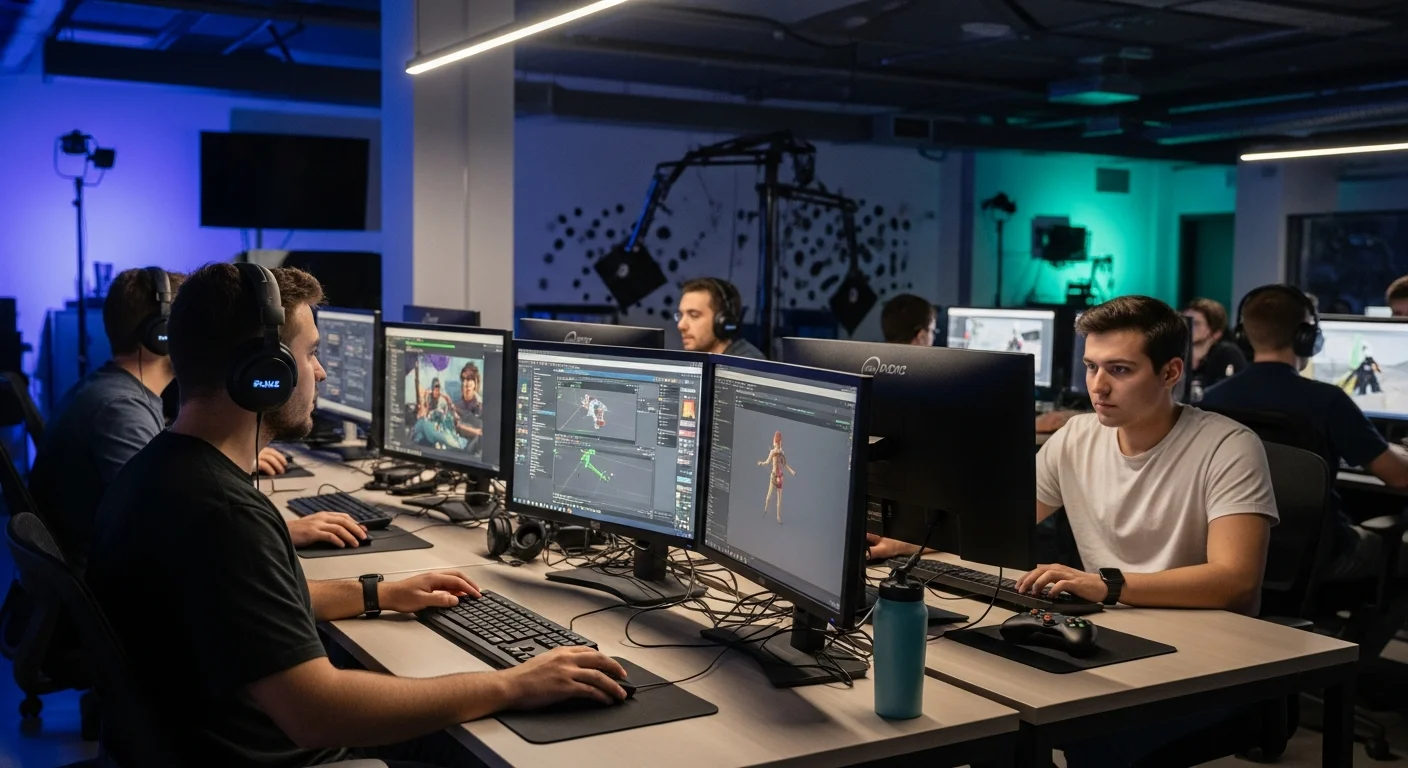
- 1.Hakia ranks the best game development degree programs in 2026, our top-ranked game development programs are University of Southern California, Rochester Institute of Technology, and University of California-Santa Cruz, selected based on graduation rates, program size, and career outcomes.
- 2.Best value: Utah Valley University offers game development degrees at just $5,614/year with a 92% graduation rate.
- 3.88 accredited game development programs available nationwide, with options at every degree level from associate's to doctoral.
Source: BLS OEWS 2024, industry analysis
Best Game Development Programs - Top 10
These are the best game development programs in the United States based on our comprehensive methodology that considers graduation rates, program size, institutional reputation, and career outcomes. Rankings are updated annually using data from IPEDS and BLS. Many students also search for game design degree programs, as game development and game design curricula share significant overlap.
Best Game Development Programs - Top 10
University of Southern California
Doctoral: Very High Research (R1)
USC pioneered interdisciplinary game education by bringing together Hollywood storytelling expertise with Silicon Valley engineering, creating the only program where students can learn from both Academy Award-winning technologists and AAA game industry veterans in the entertainment capital of the world.
University of Southern California Game Development Program Overview
Hakia ranks University of Southern California as the #1 in game development degree program.
University of Southern California's Game Development program graduates 53 students annually with a 92% graduation rate. Research opportunities include the Institute for Creative Technologies (ICT) and Creative Media & Behavioral Health Center (CMBHC). Los Angeles entertainment industry access enabling collaboration with major movie and game studios Graduates find positions at Rockstar Games, Treyarch, Unity Technologies.
Hakia Insight: Students at University of Southern California benefit from active collaborations with Scopely and U.S. Army Research Laboratory, connecting classroom learning to the workforce.
Degree Programs
Research Labs & Institutes
DoD-sponsored UARC developing virtual humans, AI, and immersive technologies for military training and healthcare
Interdisciplinary research unit developing entertainment media interventions for health and rehabilitation
Location Advantages
- •Los Angeles entertainment industry access enabling collaboration with major movie and game studios
- •Proximity to Hollywood helping ICT partnerships with blockbuster film productions
- •Silicon Beach tech ecosystem providing internship and career opportunities
Industry Partners
Career Outcomes
Rockstar Games, Treyarch, Unity Technologies, Amazon, Hypergryph
Certifications & Designations
Admissions
Rochester Institute of Technology
Doctoral: High Research (R2)
RIT was the first university to publish games to the Xbox One platform and operates MAGIC Spell Studios, where over 300 students have already published games like Changeling VR to Steam, creating a unique pipeline from student projects to commercial releases.
Rochester Institute of Technology Game Development Program Overview
Hakia ranks Rochester Institute of Technology as the #2 in game development degree program.
Rochester Institute of Technology's Game Development program graduates 154 students annually with a 90% graduation rate. Research opportunities include the MAGIC Spell Studios and Digital Games Hub. Rochester tech corridor with strong industry presence Graduates find positions at Rockstar Games, Microsoft, Electronic Arts.
Hakia Insight: Through ties with Microsoft and Tesla, Rochester Institute of Technology bridges the gap between academic training and industry practice.
Degree Programs
Research Labs & Institutes
Commercial game development and publishing for students and indie developers
Resources and mentoring for students and indie developers to enter the games industry and launch start-ups
Narrative design and interactive storytelling research
Location Advantages
- •Rochester tech corridor with strong industry presence
- •Access to Creative Industry Day networking events
- •Proximity to major tech companies in Northeast corridor
Industry Partners
Career Outcomes
Rockstar Games, Microsoft, Electronic Arts, Epic Games, Ubisoft
Certifications & Designations
Admissions
University of California-Santa Cruz
Doctoral: Very High Research (R1)
UCSC pioneered the academic study of games and is consistently ranked among the top 5 game design programs worldwide, with a unique location just one hour from Silicon Valley enabling direct industry connections while maintaining a research-focused academic environment.
University of California-Santa Cruz Game Development Program Overview
Hakia ranks University of California-Santa Cruz as the #3 in game development degree program.
University of California-Santa Cruz's Game Development program graduates 132 students annually with a 93% graduation rate. Research opportunities include the Center for Computational Experience and Alternative Learning Technologies and Games (ALT Games) Lab. One hour from Silicon Valley tech ecosystem
Hakia Insight: University of California-Santa Cruz's Alternative Learning Technologies and Games (ALT Games) Lab creates a direct research-to-career pipeline with Silicon Valley Tech Companies, bridging academic research and industry practice.
Degree Programs
Research Labs & Institutes
Interdisciplinary research center focused on human computer interaction and technology for games and play
Intersection of games, human-computer interaction, and learning science
Location Advantages
- •One hour from Silicon Valley tech ecosystem
- •Close proximity to major game studios and tech companies
- •Access to both Santa Cruz main campus and Silicon Valley campus locations
Industry Partners
Career Outcomes
Admissions
Carnegie Mellon University
Doctoral: Very High Research (R1)
CMU was one of the first universities worldwide to offer a master's degree in interaction design in the mid-1990s and houses the Entertainment Technology Center, which collaborates directly with IDeATe to deliver game design education that bridges technical excellence with creative innovation.
Carnegie Mellon University Game Development Program Overview
Hakia ranks Carnegie Mellon University as the #4 in game development degree program.
Carnegie Mellon University's Game Development program graduates 1 students annually with a 98% graduation rate. Research opportunities include the Center for Transformational Play and Entertainment Technology Center. Pittsburgh's growing tech scene
Hakia Insight: Carnegie Mellon University leverages partnerships with Simcoach Games and Twitch to offer students real-world project experience valued by employers.
Degree Programs
Research Labs & Institutes
Transformational games that change player behavior
Game design and entertainment technology
AR and VR technology development
Games and storytelling for personal expression and social dynamics
Educational games and game development
Digital learning games and educational technology
Location Advantages
- •Pittsburgh's growing tech scene
- •Access to CMU's computer science and design resources
- •Proximity to major entertainment and technology companies for internships
Industry Partners
Career Outcomes
Admissions
University of California-Irvine
Doctoral: Very High Research (R1)
Located in Silicon Beach with direct industry partnerships including Blizzard, Riot, EA, and Disney, UCI's program offers the rare combination of rigorous computer science foundations within an Informatics department that emphasizes human-centered design and the cultural impact of games.
University of California-Irvine Game Development Program Overview
Hakia ranks University of California-Irvine as the #5 in game development degree program.
University of California-Irvine's Game Development program graduates 55 students annually with a 96% graduation rate. Students benefit from cutting-edge research at the Computer Games and Virtual Worlds Research Center. Silicon Beach location in Orange County
Hakia Insight: University of California-Irvine's industry network, including Blizzard Entertainment and Riot Games, provides students with internship and hiring pathways.
Degree Programs
Research Labs & Institutes
Promotes campuswide research spanning social and technological aspects of games and virtual worlds
Location Advantages
- •Silicon Beach location in Orange County
- •Proximity to major game studios and entertainment companies
- •Close to Silicon Valley tech ecosystem
Industry Partners
Career Outcomes
Admissions
University of Miami
Doctoral: Very High Research (R1)
The Interactive Media MFA takes a multidisciplinary approach that brings together students from diverse backgrounds to explore the societal impact of interactive technologies while developing both technical skills and ethical leadership capabilities.
University of Miami Game Development Program Overview
Hakia ranks University of Miami as the #6 in game development degree program.
University of Miami's Game Development program graduates 16 students annually with a 94% graduation rate. Research opportunities include the Virtual Experience Simulation Lab (VESL) and Novel Experience & Responsible Design Lab (NERDLab). Miami's growing tech scene
Hakia Insight: University of Miami's direct partnerships with Bascom Palmer and RSMAS give students a competitive edge through industry-embedded projects and recruiting pipelines.
Degree Programs
Research Labs & Institutes
XR development and interdisciplinary prototyping
games for social impact
human-centered research and usability testing
prototyping, fabrication, AR/VR, physical computing
XR, multisensory experiences, and trustworthy AI
virtual reality, volumetric captures and augmented reality
Location Advantages
- •Miami's growing tech scene
- •Access to diverse international community
Industry Partners
Career Outcomes
Admissions
DePaul University
Doctoral: High Research (R2)
DePaul houses the professional DePaul Originals Game Studio on campus where students work on commercially shipped games, with alumni founding successful studios like Young Horses (creators of Octodad and Bugsnax) and landing positions at major studios including Blizzard, Bethesda, and NeatherRealm Studios.
DePaul University Game Development Program Overview
Hakia ranks DePaul University as the #7 in game development degree program.
DePaul University's Game Development program graduates 45 students annually with a 86% graduation rate. Research opportunities include the Virtual and Augmented Design Lab (VAD) and Hybrid Experience Lab. Located in Chicago's Loop with access to thriving tech and media industry Graduates find positions at NeatherRealm Studios, Raven, Blizzard.
Hakia Insight: Through ties with Young Horses and Iron Galaxy, DePaul University bridges the gap between academic training and industry practice.
Degree Programs
Research Labs & Institutes
Experimental games on emerging platforms including AR development with Apple ARKit and VR projects exploring deformable virtual surfaces
Research into play and games in different realities since 2006, combining immersive technologies with physical world applications
Transdisciplinary design lab creating interactive advocacy solutions for social justice, health, and environmental issues
Commercial game production and publishing to Steam, Xbox, PS4, and Switch platforms
Location Advantages
- •Located in Chicago's Loop with access to thriving tech and media industry
- •DePaul Originals Studio provides on-campus commercial game development experience
- •Proximity to major gaming companies and indie studios in Chicago area
Industry Partners
Career Outcomes
NeatherRealm Studios, Raven, Blizzard, Zynga, Bethesda
Certifications & Designations
Admissions
Michigan State University
Doctoral: Very High Research (R1)
MSU's program uniquely combines rigorous academic research on game psychology and social impact with hands-on industry partnerships, producing graduates who understand not just how to make games, but how games affect society and culture.
Michigan State University Game Development Program Overview
Hakia ranks Michigan State University as the #8 in game development degree program.
Michigan State University's Game Development program graduates 39 students annually with a 87% graduation rate. Research opportunities include the Games for Entertainment and Learning (GEL) Lab and Social and Psychological Approaches to Research on Technology-Interaction Effects (SPARTIE) Lab. East Lansing location with local game development studio presence Graduates find positions at Activision Blizzard, Bungie, EA.
Hakia Insight: Michigan State University's Games for Entertainment and Learning (GEL) Lab creates a direct research-to-career pipeline with Adventure Club Games, bridging academic research and industry practice.
Degree Programs
Research Labs & Institutes
State-of-the-art technology for game prototyping and research on social and individual effects of digital games
Research on how media technologies influence equity, well-being, and motivation across societal contexts
Location Advantages
- •East Lansing location with local game development studio presence
- •Strong ties to Michigan's growing tech sector
Industry Partners
Career Outcomes
Activision Blizzard, Bungie, EA, Insomniac, Rockstar
Certifications & Designations
Admissions
American University
Doctoral: High Research (R2)
AU offers the only Master's program in the United States specifically focused on applying game design to non-game contexts like policy, education, and social change, with unique access to Washington DC's government and policy networks.
American University Game Development Program Overview
Hakia ranks American University as the #9 in game development degree program.
American University's Game Development program graduates 6 students annually with a 96% graduation rate. Students benefit from cutting-edge research at the AU Game Center. Washington DC access to government agencies and think tanks Graduates find positions at Game design and development studios, Policy think tanks, Museums and cultural institutions.
Hakia Insight: American University leverages partnerships with National Institute of Mental Health and Smithsonian American Art Museum to offer students real-world project experience valued by employers.
Degree Programs
Research Labs & Institutes
Multi-disciplinary research in games and interactive media across education, health, community, policy, and politics
Location Advantages
- •Washington DC access to government agencies and think tanks
- •Policy and governance focus unique to capital location
- •Host site for Global Game Jam DC area
- •Connections to Indie Arcade at Smithsonian Museum and Games+ events
- •Proximity to federal contractors and NGOs
Industry Partners
Career Outcomes
Game design and development studios, Policy think tanks, Museums and cultural institutions, Educational environments
Certifications & Designations
Admissions
Worcester Polytechnic Institute
Doctoral: High Research (R2)
WPI's IMGD program is one of the only academic units in the nation that houses all areas of games and interactive media within a single program, and operates on a 'learning through making and research through design' philosophy from day one.
Worcester Polytechnic Institute Game Development Program Overview
Hakia ranks Worcester Polytechnic Institute as the #10 in game development degree program.
Worcester Polytechnic Institute's Game Development program graduates 24 students annually with a 83% graduation rate. Research opportunities include the Mixed Reality Development Group and Music, Perception, and Robotics Lab. Close proximity to major gaming industry events like PAX East Graduates find positions at Album, MITRE Corporation, Pegasystems.
Hakia Insight: Worcester Polytechnic Institute's Mixed Reality Development Group and Music, Perception, and Robotics Lab position students at the forefront of game development research.
Degree Programs
Research Labs & Institutes
Design, implementation, and analysis of virtual and augmented reality systems
Musical creativity, perception and cognition, expressive robotic and mechatronic systems
Design and analysis of distributed systems with focus on networking performance
27-seat teaching and research laboratory
Workspace for both digital and traditional art creation
Location Advantages
- •Close proximity to major gaming industry events like PAX East
- •Access to MassDiGI Game Challenge and Boston game development community
- •Located in Massachusetts tech corridor
Career Outcomes
Album, MITRE Corporation, Pegasystems, Amadeus North America, Kaon Interactive
Admissions
Best Game Development Programs - Top 10 — Complete Program Data
#1. University of Southern California Game Development Program
Hakia ranks University of Southern California as the #1 in game development degree program. Location: Los Angeles, CA | Type: Private | Tuition: $66,640/year | Graduation Rate: 92% | Score: 85.7
What makes University of Southern California stand out: USC pioneered interdisciplinary game education by bringing together Hollywood storytelling expertise with Silicon Valley engineering, creating the only program where students can learn from both Academy Award-winning technologists and AAA game industry veterans in the entertainment capital of the world.
Hakia Insight: Students at University of Southern California benefit from active collaborations with Scopely and U.S. Army Research Laboratory, connecting classroom learning to the workforce.
Program Overview: USC's game development ecosystem spans two prestigious schools, offering students multiple pathways into the interactive entertainment industry. The School of Cinematic Arts houses the Interactive Media & Games Division, consistently ranked #1 Game Design school in North America by The Princeton Review since 2009, offering comprehensive BFA and MFA programs that blend artistic creativity with technical innovation. Simultaneously, the Viterbi School of Engineering provides the MS in Computer Science - Game Development, a rigorous 32-unit program that combines core computer science fundamentals with specialized game development expertise. This dual-school approach creates a unique environment where film industry artists collaborate with computer scientists, building innovation in areas ranging from blockbuster entertainment to serious games for healthcare and military training. Students benefit from USC's Los Angeles location, helping partnerships with major movie studios and game companies, while also engaging with advanced research through the Institute for Creative Technologies (ICT), a DoD-sponsored center developing virtual humans and immersive simulations.
Degree Programs: BFA in Game Development and Interactive Design (4 years); BFA in Game Art (4 years); BFA in Themed Entertainment (4 years); MFA in Interactive Media & Games (2-3 years); MS in Computer Science - Game Development (2 years); MA in Cinematic Arts (Media Arts, Games and Health) (2 years)
Research Labs: Institute for Creative Technologies (ICT) - DoD-sponsored UARC developing virtual humans, AI, and immersive technologies for military training and healthcare; Creative Media & Behavioral Health Center (CMBHC) - Interdisciplinary research unit developing entertainment media interventions for health and rehabilitation
Industry Partners: Scopely, U.S. Army Research Laboratory, Unity Technologies, Rockstar Games, Treyarch
Career Outcomes: Placement Rate: Strong industry placement with alumni at major AAA studios | Top Employers: Rockstar Games, Treyarch, Unity Technologies, Amazon, Hypergryph, Blue Mammoth Games, USC ICT | Common Roles: Game Designer, Software Engineer, Gameplay Programmer, System Designer, Game Developer, Level Designer
Notable Faculty: Marientina Gotsis (Games for health, interactive entertainment applications for rehabilitation)
Admissions:
Accreditations: STEM-designated programs eligible for OPT extension for international students
#2. Rochester Institute of Technology Game Development Program
Hakia ranks Rochester Institute of Technology as the #2 in game development degree program. Location: Rochester, NY | Type: Private | Tuition: $55,784/year | Graduation Rate: 90% | Score: 82.0
What makes Rochester Institute of Technology stand out: RIT was the first university to publish games to the Xbox One platform and operates MAGIC Spell Studios, where over 300 students have already published games like Changeling VR to Steam, creating a unique pipeline from student projects to commercial releases.
Hakia Insight: Through ties with Microsoft and Tesla, Rochester Institute of Technology bridges the gap between academic training and industry practice.
Program Overview: Rochester Institute of Technology's Game Design and Development program stands as a premier destination for aspiring game creators, offering both a Bachelor's and Master's degree through the School of Interactive Games and Media within the Golisano College of Computing and Information Sciences. The undergraduate BS program emphasizes game programming within a strong computing education, preparing students for careers across gaming, simulation, modeling, training, and visualization industries. What sets RIT apart is its mandatory cooperative education program, students complete two full-time, paid co-op blocks starting after their second year, gaining real-world experience at major studios while building industry connections. The program combines technical depth in areas like game engines, graphics programming, and mobile development with creative elements including game design, interactive media, animation, and user interaction. Students can customize their education through specialized electives and advance to the MS program through an accelerated bachelor's/master's pathway, all while working in professional facilities like MAGIC Spell Studios where they can commercialize their own games.
Degree Programs: Game Design and Development BS (4 years); Game Design and Development MS (2 years); Accelerated BS/MS Pathway (5 years)
Research Labs: MAGIC Spell Studios - Commercial game development and publishing for students and indie developers; Digital Games Hub - Resources and mentoring for students and indie developers to enter the games industry and launch start-ups; Center for Worldbuilding and Storytelling - Narrative design and interactive storytelling research
Industry Partners: Microsoft, Tesla, Boeing, Lockheed Martin, IBM, JPMorgan Chase & Co., U.S. Department of Defense, Alion Science and Technology, Bose, Collins Aerospace
Career Outcomes: Placement Rate: 70% for BS graduates, 72% for MS graduates | Top Employers: Rockstar Games, Microsoft, Electronic Arts, Epic Games, Ubisoft, Zynga, IBM | Common Roles: Game Developer, Software Engineer, Game Designer, Level Designer, Tech Artist, UI/UX Designer, Quality Assurance Engineer
Notable Faculty: David Schwartz (Digital twins and virtual environments); Elouise Oyzon (Game development and virtual reality)
Admissions: GPA: 3.25 minimum recommended for MS program | Acceptance Rate: not specified
Accreditations: STEM-OPT eligible program, New York State Center of Excellence in Digital Game Development
#3. University of California-Santa Cruz Game Development Program
Hakia ranks University of California-Santa Cruz as the #3 in game development degree program. Location: Santa Cruz, CA | Type: Public | Tuition: $11,834/year | Graduation Rate: 93% | Score: 80.4
What makes University of California-Santa Cruz stand out: UCSC pioneered the academic study of games and is consistently ranked among the top 5 game design programs worldwide, with a unique location just one hour from Silicon Valley enabling direct industry connections while maintaining a research-focused academic environment.
Hakia Insight: University of California-Santa Cruz's Alternative Learning Technologies and Games (ALT Games) Lab creates a direct research-to-career pipeline with Silicon Valley Tech Companies, bridging academic research and industry practice.
Program Overview: UC Santa Cruz's Bachelor of Science in Computer Science: Computer Game Design represents one of the most prestigious and comprehensive game development programs in the world. This four-year undergraduate degree program uniquely fuses technical engineering prowess with artistic vision, focusing on the construction and design of interactive computer games. Students dive deep into the technical, narrative, and artistic foundations of game development, culminating in an intensive year-long game project sequence during their final year where they create professional-quality games from concept to completion. The program is consistently ranked among the top game design programs globally, holding the #5 spot for best game/simulation development program in the nation according to U.S. News & World Report 2024. What sets UCSC apart is its interdisciplinary approach spanning multiple divisions, building collaboration between engineering, arts, and social sciences. The program operates through the Baskin School of Engineering's Computational Media Department, which houses research faculty and the Center for Computational Experience - an interdisciplinary research center focused on human-computer interaction and technology for games and play.
Degree Programs: B.S. Computer Science: Computer Game Design (4 years); B.A. Art & Design: Games + Playable Media (4 years); M.S. Games + Playable Media (5 quarters (1.67 years)); M.S. Computational Media (2 years)
Research Labs: Center for Computational Experience - Interdisciplinary research center focused on human computer interaction and technology for games and play; Alternative Learning Technologies and Games (ALT Games) Lab - Intersection of games, human-computer interaction, and learning science
Industry Partners: Silicon Valley Tech Companies
Career Outcomes: | Common Roles: Gameplay engineer, Computer game designer, Computer game producer, Animation and graphics programming, Technical artist, Software engineering, Web development
Notable Faculty: Katherine Isbister (Human Computer Interaction and Games Research, emotion and social connection in digital experiences); Edward Melcer (Games, human-computer interaction, and learning science with focus on novel interfaces)
Admissions:
#4. Carnegie Mellon University Game Development Program
Hakia ranks Carnegie Mellon University as the #4 in game development degree program. Location: Pittsburgh, PA | Type: Private | Tuition: $62,260/year | Graduation Rate: 98% | Score: 78.7
What makes Carnegie Mellon University stand out: CMU was one of the first universities worldwide to offer a master's degree in interaction design in the mid-1990s and houses the Entertainment Technology Center, which collaborates directly with IDeATe to deliver game design education that bridges technical excellence with creative innovation.
Hakia Insight: Carnegie Mellon University leverages partnerships with Simcoach Games and Twitch to offer students real-world project experience valued by employers.
Program Overview: Carnegie Mellon's game development education spans multiple prestigious schools, offering an unprecedented interdisciplinary approach through the IDeATe (Integrative Design, Arts, and Technology) program and the Entertainment Technology Center. The undergraduate Game Design minor requires 45 units and combines technical programming skills with creative storytelling, drawing from CMU's world-renowned computer science, design, and arts programs. Students master game systems design, interactive narrative development, visual asset creation, and collaborative design processes through hands-on coursework taught by faculty experts from the Entertainment Technology Center. The program emphasizes both the artistic craft and technical science of game creation, with opportunities to build substantial portfolios while working across disciplines that few universities can match.
Degree Programs: Game Design Minor (Integrated with undergraduate major)
Research Labs: Center for Transformational Play - Transformational games that change player behavior; Entertainment Technology Center - Game design and entertainment technology; Extended Reality Technology Center - AR and VR technology development; eHeart Lab - Games and storytelling for personal expression and social dynamics; Human-Centered Data Lab - Educational games and game development; McLearn Lab - Digital learning games and educational technology
Industry Partners: Simcoach Games, Twitch
Career Outcomes: | Common Roles: Game Designer, Interactive Narrative Designer, Game Programmer, User Experience Designer, Creative Director
Notable Faculty: Jessica Hammer (Transformational games and educational game design)
Admissions:
#5. University of California-Irvine Game Development Program
Hakia ranks University of California-Irvine as the #5 in game development degree program. Location: Irvine, CA | Type: Public | Tuition: $11,834/year | Graduation Rate: 96% | Score: 76.6
What makes University of California-Irvine stand out: Located in Silicon Beach with direct industry partnerships including Blizzard, Riot, EA, and Disney, UCI's program offers the rare combination of rigorous computer science foundations within an Informatics department that emphasizes human-centered design and the cultural impact of games.
Hakia Insight: University of California-Irvine's industry network, including Blizzard Entertainment and Riot Games, provides students with internship and hiring pathways.
Program Overview: UC Irvine's Game Design and Interactive Media program represents one of the most comprehensive undergraduate experiences in game development education. This Bachelor of Science degree, housed within the Department of Informatics in the Donald Bren School of Information and Computer Sciences, combines rigorous technical programming foundations with creative design principles across a unique two-year foundation curriculum. Students dive deep into worldbuilding, game programming in engines like Unity, visual design fundamentals, and critical game studies before pursuing specialized tracks in their final years. The program culminates in a two-quarter capstone project supported by industry mentors, where students create portfolio-ready games that showcase their individual interests and career goals. What sets UCI apart is its location in Orange County's 'Silicon Beach' - placing students at the heart of Southern California's booming game industry. The program maintains active partnerships with industry giants including Blizzard Entertainment, Riot Games, Electronic Arts, Obsidian Entertainment, Disney, and Cartoon Network, providing students with internship opportunities and real-world project experience. The curriculum explores both traditional and emerging platforms, from mobile and AR/VR to tabletop games, preparing graduates for the rapidly evolving interactive entertainment landscape.
Degree Programs: B.S. Game Design and Interactive Media (4 years (3 years minimum for transfers))
Research Labs: Computer Games and Virtual Worlds Research Center - Promotes campuswide research spanning social and technological aspects of games and virtual worlds
Industry Partners: Blizzard Entertainment, Riot Games, Electronic Arts, Obsidian Entertainment, Disney, Cartoon Network, Tencent, Age of Learning
Career Outcomes: | Common Roles: Game Designer, Game Developer, Interactive Entertainment Professional, Educational Software Developer, Serious Games Developer
Notable Faculty: undefined (Internationally-recognized faculty and industry experts)
Admissions: GPA: 3.0 minimum UC transferable GPA for transfers
#6. University of Miami Game Development Program
Hakia ranks University of Miami as the #6 in game development degree program. Location: Coral Gables, FL | Type: Private | Tuition: $58,104/year | Graduation Rate: 94% | Score: 65.0
What makes University of Miami stand out: The Interactive Media MFA takes a multidisciplinary approach that brings together students from diverse backgrounds to explore the societal impact of interactive technologies while developing both technical skills and ethical leadership capabilities.
Hakia Insight: University of Miami's direct partnerships with Bascom Palmer and RSMAS give students a competitive edge through industry-embedded projects and recruiting pipelines.
Program Overview: Based on the available sources, the University of Miami doesn't appear to offer a dedicated Game Development program. The closest related offering is the M.F.A. in Interactive Media through the School of Communication, which is a 45-credit terminal degree that prepares students to design meaningful experiences through emerging technologies. This program focuses on interactive entertainment, interactive product design, and game design as part of its broader curriculum in interaction design. The program combines design, technology, and human behavior study, preparing graduates for careers as interactive product designers, game designers, and similar roles in the interactive entertainment industry. Students complete core courses in Innovation Design, Creative Coding, Designing Playful Experiences, and Visual Design for Interactive Media, followed by collaborative labs and capstone projects that culminate in an advanced interactive project portfolio.
Degree Programs: B.S.C. in Interactive Media; B.S.C. in Immersive Media; Minor in Game Design
Research Labs: Virtual Experience Simulation Lab (VESL) - XR development and interdisciplinary prototyping; Novel Experience & Responsible Design Lab (NERDLab) - games for social impact; User Experience Lab - human-centered research and usability testing; Emerging Media Lab - prototyping, fabrication, AR/VR, physical computing; Future Realities Research Lab - XR, multisensory experiences, and trustworthy AI; XR Studio - virtual reality, volumetric captures and augmented reality
Industry Partners: Bascom Palmer, RSMAS, Miller School of Medicine, UHealth
Career Outcomes: | Common Roles: Interactive Product Designer, Game Designer, Interaction Design roles
Notable Faculty: Kim Grinfeder (Professor and Department Chair)
Admissions:
#7. DePaul University Game Development Program
Hakia ranks DePaul University as the #7 in game development degree program. Location: Chicago, IL | Type: Private | Tuition: $43,379/year | Graduation Rate: 86% | Score: 62.6
What makes DePaul University stand out: DePaul houses the professional DePaul Originals Game Studio on campus where students work on commercially shipped games, with alumni founding successful studios like Young Horses (creators of Octodad and Bugsnax) and landing positions at major studios including Blizzard, Bethesda, and NeatherRealm Studios.
Hakia Insight: Through ties with Young Horses and Iron Galaxy, DePaul University bridges the gap between academic training and industry practice.
Program Overview: DePaul University's Game Development program spans the Jarvis College of Computing and Digital Media with multiple pathways including a BS in Game Design and MS in Game Programming. The program stands out for its integration of technical programming skills with creative design thinking, housed in advanced facilities like the 8,000 square-foot Jarvis Student Center for Innovation and Collaboration. Students work in specialized labs including the Virtual and Augmented Design Lab, game development and research labs, and playtest and usability facilities. The program emphasizes real-world experience through DePaul Originals Game Studio, where students create commercial games shipped to platforms like Steam, Xbox, PS4, and Switch. Faculty include industry veterans like Allen Turner, former lead designer at Wideload Games/Disney Interactive Studio, and researchers pushing boundaries in VR/AR and social justice gaming.
Degree Programs: BS in Game Design (4 years); MS in Game Programming (2 years)
Research Labs: Virtual and Augmented Design Lab (VAD) - Experimental games on emerging platforms including AR development with Apple ARKit and VR projects exploring deformable virtual surfaces; Hybrid Experience Lab - Research into play and games in different realities since 2006, combining immersive technologies with physical world applications; Matters at Play (M@P) - Transdisciplinary design lab creating interactive advocacy solutions for social justice, health, and environmental issues; DePaul Originals Game Studio - Commercial game production and publishing to Steam, Xbox, PS4, and Switch platforms
Industry Partners: Young Horses, Iron Galaxy, Jackbox Games
Career Outcomes: Placement Rate: 88% of Computing and Digital Media graduates were employed, continuing education or not seeking employment after graduation | Top Employers: NeatherRealm Studios, Raven, Blizzard, Zynga, Bethesda, Zenimax, Iron Galaxy, Jackbox Games, US Army, Schell Games | Common Roles: Game Designer, Game Programmer, Level Designer, Producer, Independent Game Developer
Notable Faculty: Allen Turner (Creative Director of DePaul Originals Game Studio); Brian Schrank (Virtual and Augmented Reality); Richard Wetzel (Immersive technologies and serious games); Lien Tran (Social justice game design)
Admissions:
Accreditations: Unity Certified Professional, Unreal Engine Certification
#8. Michigan State University Game Development Program
Hakia ranks Michigan State University as the #8 in game development degree program. Location: East Lansing, MI | Type: Public | Tuition: $16,930/year | Graduation Rate: 87% | Score: 61.8
What makes Michigan State University stand out: MSU's program uniquely combines rigorous academic research on game psychology and social impact with hands-on industry partnerships, producing graduates who understand not just how to make games, but how games affect society and culture.
Hakia Insight: Michigan State University's Games for Entertainment and Learning (GEL) Lab creates a direct research-to-career pipeline with Adventure Club Games, bridging academic research and industry practice.
Program Overview: Michigan State University's Game Design and Development program, established in 2005, has rapidly evolved into a Top 10 ranked program by the Princeton Review, housed within the College of Communication Arts and Sciences. Students pursue a Bachelor of Arts in Games and Interactive Media, gaining comprehensive knowledge in art, design, and programming fundamentals of digital game development, while also studying the history, social impacts, and business aspects of games. The program takes a distinctly interdisciplinary approach, bringing together designers, artists, and programmers in collaborative, project-based learning that mirrors real industry practices. Through partnerships with game studios, students gain authentic, real-world experience that culminates in a strong portfolio of games and interactive media projects. The program is anchored by the Games for Entertainment and Learning (GEL) Lab, which provides students with state-of-the-art technology for designing prototypes and advancing research on the social and individual effects of digital games. Faculty include both academic researchers and industry professionals, such as Ricardo Guimaraes, a concept artist and illustrator with extensive entertainment industry experience from Brazil, and Casey O'Donnell, whose research spans game development companies from the United States to India and who has personally developed multiple games including 'Osy,' 'Against the Gradient,' and 'GLITcH.'
Degree Programs: Bachelor of Arts in Games and Interactive Media (4 years); Minor in Game Design and Development; Serious Games Graduate Certificate
Research Labs: Games for Entertainment and Learning (GEL) Lab - State-of-the-art technology for game prototyping and research on social and individual effects of digital games; Social and Psychological Approaches to Research on Technology-Interaction Effects (SPARTIE) Lab - Research on how media technologies influence equity, well-being, and motivation across societal contexts
Industry Partners: Adventure Club Games
Career Outcomes: | Top Employers: Activision Blizzard, Bungie, EA, Insomniac, Rockstar, Ubisoft | Common Roles: Game designers and developers, Interactive media and multimedia designers, Narrative designers, Character developers, Technical artists, Game players and usability testers, Platform and system engineers
Notable Faculty: Brian Winn (Interactive media design, game design, digital game-based learning, interactive health communication); Casey O'Donnell (Creative collaborative work of videogame design and development, cultural dynamics in game development companies); Wei Peng (Games for health and learning applications); Rabindra Ratan (How media technologies influence meaningful outcomes across societal contexts); Andrew Dennis (Artist, designer, and co-founder at Adventure Club Games); Ricardo Guimaraes (Concept art and illustration with entertainment industry experience)
Admissions:
Accreditations: ABET accredited (Computer Science)
#9. American University Game Development Program
Hakia ranks American University as the #9 in game development degree program. Location: Washington, DC | Type: Private | Tuition: $55,724/year | Graduation Rate: 96% | Score: 61.6
What makes American University stand out: AU offers the only Master's program in the United States specifically focused on applying game design to non-game contexts like policy, education, and social change, with unique access to Washington DC's government and policy networks.
Hakia Insight: American University leverages partnerships with National Institute of Mental Health and Smithsonian American Art Museum to offer students real-world project experience valued by employers.
Program Overview: American University's Master of Arts in Game Design is a pioneering 36-credit interdisciplinary program administered jointly by the School of Communication and the Department of Computer Science. Ranked #22 nationally by Princeton Review, this unique program focuses specifically on applying game design and engagement mechanics to non-game contexts and challenges - from education and healthcare to policy and social change. Students work within the AU Game Center, housed in the Don Myers Technology & Innovation Building, benefiting from a remarkable 4:1 student-to-faculty ratio that enables intensive mentorship and collaboration. The program emphasizes experiential learning through hands-on game development, research projects, and real-world client work with organizations like the National Institute of Mental Health, Smithsonian American Art Museum, and WAMU 88.5. What sets AU apart is its 'games plus' philosophy - moving beyond entertainment to explore games as tools for behavior change, community engagement, and addressing complex societal challenges. Located in Washington DC, students gain access to government agencies, think tanks, and policy organizations, creating games that tackle issues from mental health awareness to civic engagement. The program culminates in a substantial 6-credit Master's Portfolio Capstone where students demonstrate their ability to create meaningful, impactful games.
Degree Programs: MA in Game Design (2 years); MFA in Games and Interactive Media (3 years); Graduate Certificate in Game Design (1 year)
Research Labs: AU Game Center - Multi-disciplinary research in games and interactive media across education, health, community, policy, and politics
Industry Partners: National Institute of Mental Health, Smithsonian American Art Museum, Educational Testing Service, WAMU 88.5, DC Public Libraries, MacArthur Foundation
Career Outcomes: | Top Employers: Game design and development studios, Policy think tanks, Museums and cultural institutions, Educational environments | Common Roles: Game Designer, Educational Technology Specialist, Policy Research Analyst, Museum Interactive Developer
Notable Faculty: Andrew Phelps (Augmented reality, virtual reality, game design); Benjamin Stokes (Games for social change, educational applications); Mark Nelson (Technical games research)
Admissions: GPA: 3.0 minimum cumulative GPA in last 60 hours
Accreditations: Nationally recognized in top 25 by Princeton Review and Animation Review
#10. Worcester Polytechnic Institute Game Development Program
Hakia ranks Worcester Polytechnic Institute as the #10 in game development degree program. Location: Worcester, MA | Type: Private | Tuition: $57,960/year | Graduation Rate: 83% | Score: 61.5
What makes Worcester Polytechnic Institute stand out: WPI's IMGD program is one of the only academic units in the nation that houses all areas of games and interactive media within a single program, and operates on a 'learning through making and research through design' philosophy from day one.
Hakia Insight: Worcester Polytechnic Institute's Mixed Reality Development Group and Music, Perception, and Robotics Lab position students at the forefront of game development research.
Program Overview: Worcester Polytechnic Institute's Interactive Media & Game Development program stands among the oldest games and interactive media degrees in the nation, offering a uniquely comprehensive approach that blends visual and technical arts, programming, storytelling, music, writing, design, user experience, and production management within a single academic unit. The program features both Bachelor of Science and Bachelor of Arts tracks, along with graduate options including an MS, MFA, and a advanced PhD in Computational Media. What sets WPI's IMGD apart is its hyper-collaborative structure and project-based learning philosophy where students create everything from escape rooms and mobile games to creative coding languages, 3D character asset libraries, and interactive museum exhibits from day one. The program operates through specialized facilities including the 27-seat IMGD Lab, 25-seat Zoo Lab, Digital Art Studio, and advanced research centers like the Mixed Reality Development Group and Music, Perception, and Robotics Lab. Students can pursue concentrations in visual art, design, audio and music, technical art, or writing, while working alongside renowned faculty who regularly contribute expert analysis to major media outlets including The New York Times, Associated Press, and The Guardian. The program's accelerated BS/MS pathway allows students to complete both degrees in approximately five years, making it an efficient route for those seeking advanced expertise in this rapidly evolving field.
Degree Programs: BS in Interactive Media & Game Development (4 years); BA in Interactive Media & Game Development (4 years); MS in Interactive Media & Game Development (2 years); MFA in Interactive Media & Game Design (3 years); PhD in Computational Media (4-5 years); BS/MS Dual Degree (5 years)
Research Labs: Mixed Reality Development Group - Design, implementation, and analysis of virtual and augmented reality systems; Music, Perception, and Robotics Lab - Musical creativity, perception and cognition, expressive robotic and mechatronic systems; Performance Evaluation of Distributed Systems (PEDS) Lab - Design and analysis of distributed systems with focus on networking performance; IMGD Lab - 27-seat teaching and research laboratory; Digital Art Studio - Workspace for both digital and traditional art creation
Career Outcomes: Placement Rate: Strong industry placement | Top Employers: Album, MITRE Corporation, Pegasystems, Amadeus North America, Kaon Interactive, Volvo Trucks USA | Common Roles: VR Developer, Senior Software Engineer, Systems Engineer, Operations Research Analyst, Co-founder & CEO
Notable Faculty: Gillian Smith (Computational creativity, games and social justice, generative AI applications); Ben Schneider (Narrative design, procedural storytelling, quest design); Melissa Kagen (Experience design, anti-colonialism in games, games and performance); Mark Claypool (Distributed systems, networking, multimedia and online games)
Admissions:
Our rankings methodology weighs program strength (25%), graduation rate (20%), career outcomes (15%), institutional quality (12%), industry recognition (10%), selectivity (10%), and data transparency (8%). Learn more about our methodology →
Who Should Study Game Development?
Game development is ideal for students who combine technical aptitude with creative passion, enjoy collaborative projects, and have genuine interest in interactive entertainment. You should be prepared for intensive programming coursework and long-term project development cycles.
- Creative problem solvers who enjoy both technical and artistic challenges
- Students comfortable with programming and mathematics fundamentals
- Collaborative team players willing to work on multi-semester projects
- Gaming enthusiasts who understand game mechanics and player psychology
- Self-motivated learners who can adapt to rapidly changing technology
Consider the competitive nature of the industry: entry-level positions often require portfolios demonstrating shipped projects or polished prototypes. Success requires both technical competency and creative vision.
Game Development Degree Levels Compared
Game development education is available at multiple levels, with bachelor's degrees being the industry standard for most roles.
Game Development Programs by Degree Level
2-year programs for career entry or transfer to bachelor's programs
Top-ranked undergraduate programs nationwide
Top graduate programs for specialization and advancement
Flexible online programs for working professionals
Best Game Development Programs - Bachelor's
A bachelor's degree in game development is the standard credential for entry-level positions. These 4-year programs provide comprehensive training and hands-on experience.
Best Game Development Programs - Top 3 Bachelor's
University of Southern California
56 graduates, 92% grad rate, Score: 82.5
Rochester Institute of Technology
154 graduates, 90% grad rate, Score: 82.0
University of California-Santa Cruz
132 graduates, 93% grad rate, Score: 80.4
4. Carnegie Mellon University (Pittsburgh, PA) - Score: 78.7, Tuition: $62,260
5. University of California-Irvine (Irvine, CA) - Score: 76.6, Tuition: $11,834
6. University of Miami (Coral Gables, FL) - Score: 65.0, Tuition: $58,104
7. DePaul University (Chicago, IL) - Score: 62.6, Tuition: $43,379
8. Michigan State University (East Lansing, MI) - Score: 61.8, Tuition: $16,930
9. Worcester Polytechnic Institute (Worcester, MA) - Score: 61.5, Tuition: $57,960
10. University of Arizona (Tucson, AZ) - Score: 60.4, Tuition: $11,546
Best Game Development Programs - Master's
A master's degree in game development prepares students for senior and specialized roles. These 1-2 year programs offer advanced expertise and leadership training.
Best Game Development Programs - Top 3 Master's
University of Southern California
53 graduates, 92% grad rate, Score: 85.7
Rochester Institute of Technology
26 graduates, 90% grad rate, Score: 69.7
University of California-Santa Cruz
24 graduates, 93% grad rate, Score: 69.5
4. American University (Washington, DC) - Score: 61.6, Tuition: $55,724
5. Worcester Polytechnic Institute (Worcester, MA) - Score: 54.1, Tuition: $57,960
6. DePaul University (Chicago, IL) - Score: 53.4, Tuition: $43,379
7. Louisiana State University and Agricultural & Mechanical College (Baton Rouge, LA) - Score: 53.2, Tuition: $8,038
8. Rensselaer Polytechnic Institute (Troy, NY) - Score: 51.8, Tuition: $60,360
9. California Institute of the Arts (Valencia, CA) - Score: 50.6, Tuition: $56,074
10. Purdue University Northwest (Hammond, IN) - Score: 48.8, Tuition: $7,259
Best Game Development Programs - Online
Online game development programs offer flexibility for working professionals. Top accredited programs provide the same curriculum quality as on-campus alternatives.
Best Game Development Programs - Top 3 Online
University of Southern California
56 graduates, 92% grad rate, Score: 82.5
Rochester Institute of Technology
154 graduates, 90% grad rate, Score: 82.0
University of California-Santa Cruz
132 graduates, 93% grad rate, Score: 80.4
4. Carnegie Mellon University (Pittsburgh, PA) - Score: 78.7, Tuition: $62,260
5. University of California-Irvine (Irvine, CA) - Score: 76.6, Tuition: $11,834
6. University of Miami (Coral Gables, FL) - Score: 65.0, Tuition: $58,104
7. DePaul University (Chicago, IL) - Score: 62.6, Tuition: $43,379
8. Michigan State University (East Lansing, MI) - Score: 61.8, Tuition: $16,930
9. American University (Washington, DC) - Score: 61.6, Tuition: $55,724
10. Worcester Polytechnic Institute (Worcester, MA) - Score: 61.5, Tuition: $57,960
Best Game Development Programs - Associate's
An associate's degree in game development provides a 2-year pathway into the field. These programs are ideal for career starters or those planning to transfer to a 4-year program.
Best Game Development Programs - Top 3 Associate's
SUNY College of Technology at Alfred
3 graduates, 90% grad rate, Score: 48.0
Keiser University-Ft Lauderdale
1 graduates, 84% grad rate, Score: 45.6
Miami Dade College
21 graduates, N/A% grad rate, Score: 44.2
4. New England Institute of Technology (East Greenwich, RI) - Score: 44.1, Tuition: $33,225
5. Inter American University of Puerto Rico-Guayama (Guayama, PR) - Score: 44.1, Tuition: $4,848
6. Santa Rosa Junior College (Santa Rosa, CA) - Score: 43.9, Tuition: $1,242
7. Pratt Institute-Main (Brooklyn, NY) - Score: 41.7, Tuition: $57,659
8. Collin County Community College District (McKinney, TX) - Score: 39.6, Tuition: $3,450
9. Gwinnett Technical College (Lawrenceville, GA) - Score: 39.6, Tuition: $2,400
10. San Diego Mesa College (San Diego, CA) - Score: 38.8, Tuition: $1,104
Best Game Development Programs - Graduate
Graduate programs in game development (PhD and doctoral degrees) prepare students for research, academic, and senior leadership positions.
Best Game Development Programs - Top 3 Graduate
University of California-Berkeley
46 graduates, 96% grad rate, Score: 95.5
Carnegie Mellon University
23 graduates, 98% grad rate, Score: 88.7
Massachusetts Institute of Technology
68 graduates, N/A% grad rate, Score: 88.4
4. University of Southern California (Los Angeles, CA) - Score: 85.7, Tuition: $66,640
5. University of Illinois Urbana-Champaign (Champaign, IL) - Score: 83.8, Tuition: $14,768
6. Stanford University (Stanford, CA) - Score: 82.8, Tuition: $61,731
7. Princeton University (Princeton, NJ) - Score: 82.6, Tuition: $59,710
8. Cornell University (Ithaca, NY) - Score: 81.8, Tuition: $65,204
9. University of California-San Diego (La Jolla, CA) - Score: 79.2, Tuition: $11,834
10. Purdue University-Main Campus (West Lafayette, IN) - Score: 78.6, Tuition: $9,718
Most Affordable Game Development Programs
Looking for quality game development education without the hefty price tag? These programs offer the best value, balancing tuition costs with strong academic outcomes and career prospects. Our Value Score factors in graduation rates, program strength, and institutional quality relative to cost.
Top 5 Most Affordable Game Development Programs
| Rank | Institution | Location | Tuition | Value Score | Grad Rate |
|---|---|---|---|---|---|
| 1 | Utah Valley University | Orem, UT | $5,614 | 99.8 | 92% |
| 2 | Boise State University | Boise, ID | $5,941 | 99.0 | 89% |
| 3 | Fitchburg State University | Fitchburg, MA | $970 | 95.0 | — |
| 4 | Inter American University of Puerto Rico-Bayamon | Bayamon, PR | $4,848 | 94.6 | — |
| 5 | California State University-Chico | Chico, CA | $5,742 | 94.4 | — |
Game Development Career Outcomes
Game development offers diverse career paths with competitive compensation, though salaries vary significantly by role, experience, and company size. The industry combines traditional software developer roles with creative positions unique to interactive entertainment.
Career Paths
Game Designer
Create game mechanics, levels, and player experiences through iterative design processes.
Technical Artist
Bridge art and programming teams, creating tools and optimizing visual content pipelines.
Game Producer
Manage development teams, schedules, and budgets to deliver games on time and budget.
Quality Assurance Engineer
Test games for bugs, balance issues, and user experience problems before release.
UI/UX Designer
Design intuitive interfaces and user experiences for games across multiple platforms.
Game Development Curriculum Overview
Game development programs combine computer science fundamentals with specialized gaming coursework, emphasizing hands-on project development and team collaboration.
- Programming Fundamentals: C++, C#, Python, object-oriented design patterns
- Game Engines: Unity, Unreal Engine, custom engine development
- Graphics Programming: OpenGL, DirectX, shaders, 3D mathematics
- Game Design: Mechanics, player psychology, level design, narrative
- Project Management: Agile development, version control, team collaboration
- Specialized Tracks: Mobile development, VR/AR, AI programming, audio systems
Most programs require capstone projects involving full game development cycles, from concept to playable prototype. Team projects simulate real industry collaboration and portfolio development.
Game Development Programs by State
Game Development vs Related Fields
Game development is multidisciplinary, combining programming, art, design, audio, and storytelling. The technical requirements, real-time graphics, physics simulation, AI, are demanding, but technical skills alone don't make great games.
The industry is notoriously competitive with difficult working conditions. Crunch time, layoffs, and studio closures are common. Passion for games helps sustain people through these challenges, but realistic expectations about the industry are important.
Many game programming skills transfer to other fields, graphics programming applies to visualization and simulation, game AI relates to robotics and autonomous systems, and performance optimization is valuable everywhere. Some developers enter games and later transition to better-compensated industries.
Launch Your Tech Career with Springboard
6 Career Tracks · $23K avg salary increase · 85.6% placement rate
Data Science
6 months·+$25K
Machine Learning & AI
9 months·+$25K
Cybersecurity
6 months·+$11K
Data Analytics
6 months·+$17K
Software Engineering
9 months·+$25K
UI/UX Design
9 months·+$24K
Affiliate link · We may earn a commission at no extra cost to you.
- You're passionate specifically about interactive entertainment
- You enjoy combining technical and creative problem-solving
- You want to work on long-term collaborative projects
- You're willing to enter a competitive but rewarding industry
- You want broader career flexibility across all tech industries
- You prefer theoretical foundations over specialized applications
- You're interested in algorithms, systems, or research
- You want maximum job security and salary potential
- You want to focus on building software products generally
- You prefer business applications over entertainment
- You want faster entry into high-paying development roles
- You're less interested in graphics and creative aspects
Is a Game Development Degree Worth It?
For students genuinely passionate about game development, yes. The degree provides structured learning, industry connections, and portfolio development opportunities that are difficult to replicate independently. However, the field is competitive and requires dedication.
When it's worth it: You have genuine passion for games, strong technical aptitude, willingness to work on long-term projects, and understanding that entry-level competition is intense. The credential opens doors at major studios and provides comprehensive foundations.
When to consider alternatives: You're primarily interested in general software development (choose computer science), want maximum job security (software engineering), or prefer self-directed learning (indie development path with coding bootcamps).
Alternative Paths to Game Development
Several alternative paths exist for aspiring game developers, especially those seeking faster entry or specific skill development
- Software Engineering Bootcamps. Build programming foundations quickly, then specialize in games
- Self-Taught vs Degree. Many indie developers succeed through self-study and online resources
- Building a Portfolio. Essential for game industry entry regardless of education path
- Technical Interview Prep. Programming interview skills for studio positions
Many successful game developers combine formal education with self-study, online courses, and personal projects. The game industry values demonstrable skills and shipped projects as much as formal credentials.
Coding Bootcamps: An Alternative Pathway
Coding bootcamps offer an accelerated pathway into game development careers. For those considering alternatives to traditional degrees, here's what you need to know about this intensive learning format.
What is a Coding Bootcamp?
A coding bootcamp is an intensive, short-term training program (typically 12-24 weeks) that teaches practical programming skills through hands-on projects. Unlike traditional degrees, bootcamps focus exclusively on job-ready skills and often include career services to help graduates land their first tech role.
Who Bootcamps Are Best For
- Career changers looking to enter tech quickly
- Professionals wanting to upskill or transition roles
- Self-taught developers seeking structured training
- Those unable to commit to a 4-year degree timeline
What People Love
Based on discussions from r/codingbootcamp, r/cscareerquestions, and r/learnprogramming
- Fast-track to employment, many graduates land jobs within 3-6 months
- Hands-on, project-based learning builds real portfolio pieces
- Career services and interview prep included in most programs
- Strong alumni networks for job referrals and mentorship
- Structured curriculum keeps you accountable and on track
Common Concerns
Honest feedback from bootcamp graduates and industry professionals
- Intense pace can be overwhelming, expect 60-80 hour weeks
- Some employers still prefer traditional CS degrees for certain roles
- Quality varies widely between programs, research carefully
- Job placement stats can be misleading, ask for CIRR audited reports
- May lack depth in computer science fundamentals like algorithms
Save $1000 on Springboard Bootcamps
Springboard offers career-focused bootcamps with 1-on-1 mentorship from industry professionals. Their programs include a job guarantee, complete all requirements, and if you don't land a qualifying role, you may be eligible for a full tuition refund. Use our exclusive link to save $1000 on enrollment.
Programs for Game Development careers:
- Software Engineering Career Track
We may earn a commission when you use our affiliate link and coupon.
More Bootcamp Resources
Game Development Degree FAQ
Based on 742 programs from IPEDS 2023
Our rankings are based on analysis of game development degree programs nationwide using IPEDS 2023 data and BLS labor statistics. Rankings are produced algorithmically without editorial intervention, ensuring objectivity and reproducibility.
Ranking Factors
Number of graduates per year in this specific field (CIP code). Larger programs indicate established departments with more resources, course offerings, and career services. Measured from IPEDS Completions data.
Percentage of students completing their degree within 150% of expected time (6 years for bachelor's, 3 years for associate's). Higher rates indicate better student support and program quality. Source: IPEDS Graduation Rates survey.
Admission rate (lower = more selective). More selective institutions have stronger academic environments and more competitive graduates. For open-admission institutions, we use graduation rates as a proxy for quality.
National salary data for game development graduates, factored into institutional scores based on job market strength.
Ranking Categories
Overall quality using all four factors weighted as shown above. Ideal for students seeking the strongest academic experience.
Same methodology, filtered to schools with fully online or hybrid options (IPEDS Distance Education data). Some schools may have lower graduation rates due to different student demographics.
Ranked primarily by net cost (tuition minus average institutional aid), with quality factors as tiebreakers. Best for cost-conscious students.
Data Sources
- IPEDS 2023 — Institutional characteristics, completions, graduation rates
- BLS OEWS 2024 — National and metro salary data by occupation
- CIP Code Mapping — Programs identified using Classification of Instructional Programs codes
Related Resources

Taylor Rupe
Co-founder & Editor (B.S. Computer Science, Oregon State • B.A. Psychology, University of Washington)
Taylor combines technical expertise in computer science with a deep understanding of human behavior and learning. His dual background drives Hakia's mission: leveraging technology to build authoritative educational resources that help people make better decisions about their academic and career paths.