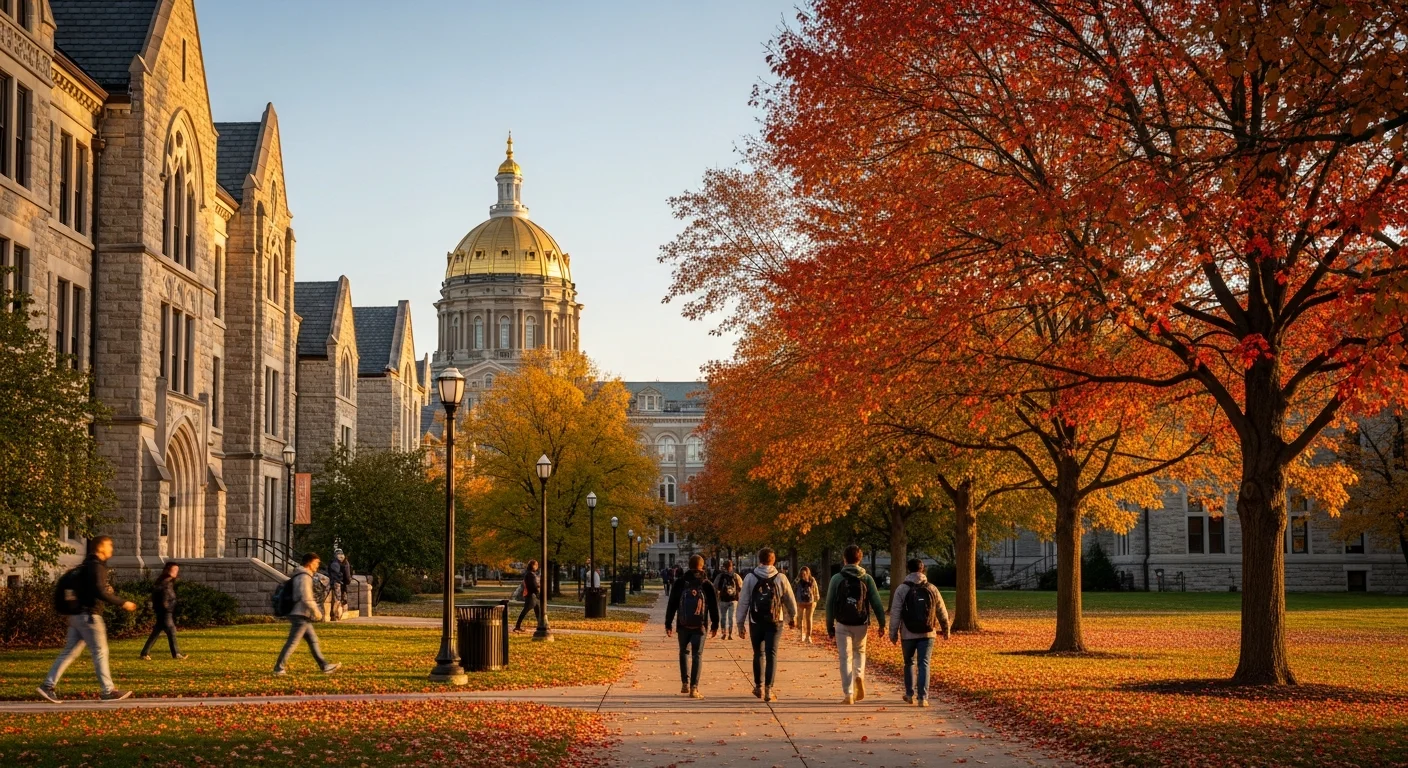
University campus in Iowa
Updated January 2026

Best Cybersecurity Degree Programs in Iowa — 2026 Rankings

Compare the top cybersecurity colleges in Iowa. 9 accredited cybersecurity schools ranked by graduation rate, career outcomes, and value—from Des Moines Area Community College to Saint Ambrose University.

#1 ProgramSaint Ambrose
Avg Salary$89,450
Tuition From$5,550/yr
Job Growth+22%

Key Takeaways

Best cybersecurity degree programs: Saint Ambrose, ,

Ranked by graduation rates, program outcomes, and institutional quality

IPEDS 2023

Tuition ranges from $4,152 to $35,318/year

Des Moines Area Community... offers the most affordable option at $5,550/yr

IPEDS 2023

Cybersecurity degree programs available: 7 associate's, 2 master's in Iowa

From community college pathways to advanced research degrees

IPEDS 2023

2 online cybersecurity degree programs in Iowa

Flexible scheduling for working professionals

IPEDS 2023

Iowa community college transfer can save 40-60% on total degree costs

7 associate's programs provide transfer pathways to bachelor's degrees

Education Commission of the States

Major employers: Principal Financial, Wellmark, Rockwell Collins, John Deere

Tech hubs in Des Moines and Cedar Rapids

Hakia Research 2026

Cybersecurity degree programs near 43+ cities across Iowa

Search by city to find programs within 200 miles of your location

IPEDS 2023

Updated February 2026

On This Page
$89,450
Are Cybersecurity Degree Programs in Iowa Worth It?
Yes. The best cybersecurity degree programs in Iowa deliver strong ROI—graduates earn $89,450 median salary with +22% job growth through 2032. In-state tuition averages $9,161/year.

Source: BLS OEWS May 2024

Best Cybersecurity Bachelor's Programs in Iowa, 2026

1
Programs
$89,450
Median Salary
$35,318/yr
Avg Tuition

Rankings based on program completions, graduation rates, selectivity, and career outcomes. See our methodology

Program Landscape

Iowa ranks among the nation's top destinations for cybersecurity education, with 1 accredited bachelor's degree programs across 0 public and 1 private institutions. The highest-ranked programs are Saint Ambrose, recognized for academic excellence, research opportunities, and strong industry connections.

Career Outcomes

Graduates from Iowa cybersecurity programs earn a median salary of $76,033—23% below the national average. The state's robust technology sector, anchored by the Des Moines, Cedar Rapids, Iowa City metropolitan areas, provides abundant internship and employment opportunities with companies including Principal Financial, Wellmark, Rockwell Collins.

Costs & Value

Tuition ranges from $35,318 to $35,318 annually, with an average of $35,318/yr. Top programs maintain graduation rates above 0%, with the highest reaching -Infinity%. Many programs hold ABET accreditation, the gold standard for computing education, ensuring curriculum meets rigorous industry standards.

Curriculum & Specializations

Students can choose from specializations including software engineering, cybersecurity, artificial intelligence, data science, and systems architecture. Strong industry partnerships provide access to co-op programs, capstone projects with real companies, and direct recruiting pipelines to Iowa's leading technology employers. For students seeking cybersecurity degrees in Iowa, these top-ranked cybersecurity schools offer the strongest combination of academic rigor and career preparation.

Earn your bachelor's in Cybersecurity

(Sponsored)

Loading programs...

🥇

Saint Ambrose University

Private
Davenport, IA
$35,318
Tuition/yr
$1,050
Per Credit
46.4
Score
Website

Best Cybersecurity Master's Programs in Iowa, 2026

2
Programs
$89,450
Median Salary
$22,150/yr
Avg Tuition
99%
Avg Grad Rate

Rankings based on program completions, graduation rates, selectivity, and career outcomes. See our methodology

Program Landscape

Iowa offers 2 master's degree programs in cybersecurity, designed for professionals seeking to advance into senior engineering, technical leadership, and specialized roles. The top programs—Iowa State, Saint Ambrose—combine advanced technical training with research opportunities and leadership development.

Career Outcomes

Master's graduates in Iowa earn a median salary of $89,450, approximately 20-30% higher than bachelor's degree holders. The concentration of technology companies in Des Moines, Cedar Rapids, Iowa City creates strong demand for graduate-level talent, with Principal Financial, Wellmark, Rockwell Collins actively recruiting from these programs.

Costs & Value

Program formats include traditional full-time study (typically 2 years), part-time options for working professionals (2-3 years), and accelerated tracks. Tuition averages $22,150/yr, with many employers offering tuition reimbursement for graduate education. Some programs offer thesis and non-thesis tracks, allowing students to focus on research or professional development based on their career goals.

Curriculum & Specializations

Curriculum covers advanced topics including machine learning, distributed systems, software architecture, and technical management. Many programs include practicum experiences, industry capstone projects, or consulting engagements that provide real-world application of advanced concepts. Among Iowa's cybersecurity schools at the graduate level, these programs stand out for both academic quality and career outcomes.

Advance your career with a Cybersecurity master's degree

(Sponsored)

Loading programs...

🥇

Iowa State University

PublicNSA CAE
Ames, IA
$8,982
Tuition/yr
$376
Per Credit
99%
Grad Rate
60.9
Score
Website
🥈

Saint Ambrose University

Private
Davenport, IA
$35,318
Tuition/yr
$1,050
Per Credit
51.0
Score
Website

Best Cybersecurity Associate's Programs in Iowa, 2026

7
Programs
$89,450
Median Salary
$5,450/yr
Avg Tuition

Rankings based on program completions, graduation rates, selectivity, and career outcomes. See our methodology

Program Landscape

Iowa offers 7 accredited associate's degree programs in cybersecurity, providing an affordable entry point into the technology field. The top-ranked programs include Des Moines Area Community..., Kirkwood Community College, Western Iowa Tech Communi..., which combine rigorous technical curriculum with practical skills training.

Costs & Value

Community colleges in Iowa offer these two-year programs at an average cost of $5,450/yr—significantly less than four-year university tuition. Students completing associate's degrees can pursue entry-level technical positions and transfer opportunities, with entry-level salaries averaging $49,198 in Iowa.

Career Pathways

Many programs feature guaranteed transfer agreements with Iowa's public universities, allowing students to complete their first two years at reduced cost before transferring to complete a bachelor's degree. The Des Moines, Cedar Rapids, Iowa City areas offer particularly strong job markets for associate's degree holders, with employers like Principal Financial, Wellmark, Rockwell Collins hiring for technical support, junior development, and IT specialist positions.

Curriculum & Specializations

Programs typically include coursework in programming fundamentals, database management, networking basics, and software development. Among cybersecurity schools in Iowa, these associate's programs offer the best value for students beginning their cybersecurity degrees in Iowa.

Start your Cybersecurity career with an associate's degree

(Sponsored)

Loading programs...

🥇

Des Moines Area Community College

Public
Ankeny, IA
$5,550
Tuition/yr
$185
Per Credit
59.3
Score
Website
🥈

Kirkwood Community College

Public
Cedar Rapids, IA
$5,880
Tuition/yr
$210
Per Credit
51.4
Score
Website
🥉

Western Iowa Tech Community College

Public
Sioux City, IA
$4,152
Tuition/yr
$173
Per Credit
47.9
Score
Website
#4

North Iowa Area Community College

Public
Mason City, IA
$5,618
Tuition/yr
$188
Per Credit
44.2
Score
Website
#5

Eastern Iowa Community College District

Public
Davenport, IA
$4,680
Tuition/yr
$195
Per Credit
40.5
Score
Website

Complete Cybersecurity Degree Program Rankings in Iowa

Best Associate's Cybersecurity Degree Programs in Iowa

### Program Landscape Iowa offers **7 accredited** associate's degree programs in cybersecurity, providing an affordable entry point into the technology field. The top-ranked programs include **Des Moines Area Community...**, **Kirkwood Community College**, **Western Iowa Tech Communi...**, which combine rigorous technical curriculum with practical skills training. ### Costs & Value Community colleges in Iowa offer these two-year programs at an average cost of **$5,450/yr**—significantly less than four-year university tuition. Students completing associate's degrees can pursue entry-level technical positions and transfer opportunities, with entry-level salaries averaging **$49,198** in Iowa. ### Career Pathways Many programs feature guaranteed transfer agreements with Iowa's public universities, allowing students to complete their first two years at reduced cost before transferring to complete a bachelor's degree. The Des Moines, Cedar Rapids, Iowa City areas offer particularly strong job markets for associate's degree holders, with employers like Principal Financial, Wellmark, Rockwell Collins hiring for technical support, junior development, and IT specialist positions. ### Curriculum & Specializations Programs typically include coursework in programming fundamentals, database management, networking basics, and software development. Among cybersecurity schools in Iowa, these associate's programs offer the best value for students beginning their cybersecurity degrees in Iowa.

  1. #1. Des Moines Area Community College

    Hakia ranks Des Moines Area Community College as the #1 associate's in cybersecurity degree program in Iowa. This public institution in Ankeny, IA has annual tuition of $5,550 ($185/credit). Ranking score: 59.3.

  2. #2. Kirkwood Community College

    Hakia ranks Kirkwood Community College as the #2 associate's in cybersecurity degree program in Iowa. This public institution in Cedar Rapids, IA has annual tuition of $5,880 ($210/credit). Ranking score: 51.4.

  3. #3. Western Iowa Tech Community College

    Hakia ranks Western Iowa Tech Community College as the #3 associate's in cybersecurity degree program in Iowa. This public institution in Sioux City, IA has annual tuition of $4,152 ($173/credit). Ranking score: 47.9.

  4. #4. North Iowa Area Community College

    Hakia ranks North Iowa Area Community College as the #4 associate's in cybersecurity degree program in Iowa. This public institution in Mason City, IA has annual tuition of $5,618 ($188/credit). Ranking score: 44.2.

  5. #5. Eastern Iowa Community College District

    Hakia ranks Eastern Iowa Community College District as the #5 associate's in cybersecurity degree program in Iowa. This public institution in Davenport, IA has annual tuition of $4,680 ($195/credit). Ranking score: 40.5.

  6. #6. Iowa Western Community College

    Hakia ranks Iowa Western Community College as the #6 associate's in cybersecurity degree program in Iowa. This public institution in Council Bluffs, IA has annual tuition of $6,270 ($209/credit). Ranking score: 40.5.

  7. #7. Northwest Iowa Community College

    Hakia ranks Northwest Iowa Community College as the #7 associate's in cybersecurity degree program in Iowa. This public institution in Sheldon, IA has annual tuition of $6,000 ($200/credit). Ranking score: 39.3.

Online Associate's Cybersecurity Degree Programs in Iowa

### Online Program Options Iowa's community colleges offer 2 online associate's cybersecurity programs, providing flexible pathways for students balancing education with work or family responsibilities. Top-ranked online programs include **North Iowa Area Community...**, **Northwest Iowa Community ...**, all regionally accredited and recognized by Iowa employers. ### Costs & Employer Recognition Online associate's programs average **$5,809/yr**—often comparable to or less than on-campus tuition. Iowa-based employers including Principal Financial, Wellmark, Rockwell Collins value online credentials from accredited institutions, recognizing that program quality matters more than delivery format. The Des Moines, Cedar Rapids, Iowa City job market actively recruits graduates from online programs. ### Program Format These programs feature asynchronous coursework for maximum flexibility, with some offering synchronous sessions for collaborative learning. Students can typically complete **60 credit hours** in 2 years while working full-time. ### Technology & Flexibility Technology requirements include reliable internet access and a modern computer. Programs provide virtual labs, online tutoring, career services, and networking opportunities. Many offer start dates throughout the year and accelerated course formats for motivated students. Graduates earn the same degree as on-campus students, with no distinction on transcripts or diplomas. For students pursuing online cybersecurity degrees in Iowa, these accredited cybersecurity schools offer the flexibility and quality that today's learners demand.

  • North Iowa Area Community College - Mason City, IA - Tuition: $5,618/year
  • Northwest Iowa Community College - Sheldon, IA - Tuition: $6,000/year

Best Bachelor's Cybersecurity Degree Programs in Iowa

### Program Landscape Iowa ranks among the nation's top destinations for cybersecurity education, with **1 accredited** bachelor's degree programs across **0 public** and **1 private** institutions. The highest-ranked programs are **Saint Ambrose**, recognized for academic excellence, research opportunities, and strong industry connections. ### Career Outcomes Graduates from Iowa cybersecurity programs earn a median salary of **$76,033**—23% below the national average. The state's robust technology sector, anchored by the Des Moines, Cedar Rapids, Iowa City metropolitan areas, provides abundant internship and employment opportunities with companies including Principal Financial, Wellmark, Rockwell Collins. ### Costs & Value Tuition ranges from **$35,318** to **$35,318** annually, with an average of **$35,318/yr**. Top programs maintain graduation rates above **0%**, with the highest reaching **-Infinity%**. Many programs hold ABET accreditation, the gold standard for computing education, ensuring curriculum meets rigorous industry standards. ### Curriculum & Specializations Students can choose from specializations including software engineering, cybersecurity, artificial intelligence, data science, and systems architecture. Strong industry partnerships provide access to co-op programs, capstone projects with real companies, and direct recruiting pipelines to Iowa's leading technology employers. For students seeking cybersecurity degrees in Iowa, these top-ranked cybersecurity schools offer the strongest combination of academic rigor and career preparation.

  1. #1. Saint Ambrose University

    Hakia ranks Saint Ambrose University as the #1 bachelor's in cybersecurity degree program in Iowa. This private institution in Davenport, IA has annual tuition of $35,318 ($1050/credit). Ranking score: 46.4.

Best Master's Cybersecurity Degree Programs in Iowa

### Program Landscape Iowa offers **2** master's degree programs in cybersecurity, designed for professionals seeking to advance into senior engineering, technical leadership, and specialized roles. The top programs—**Iowa State**, **Saint Ambrose**—combine advanced technical training with research opportunities and leadership development. ### Career Outcomes Master's graduates in Iowa earn a median salary of **$89,450**, approximately **20-30% higher** than bachelor's degree holders. The concentration of technology companies in Des Moines, Cedar Rapids, Iowa City creates strong demand for graduate-level talent, with Principal Financial, Wellmark, Rockwell Collins actively recruiting from these programs. ### Costs & Value Program formats include traditional full-time study (typically 2 years), part-time options for working professionals (2-3 years), and accelerated tracks. Tuition averages **$22,150/yr**, with many employers offering tuition reimbursement for graduate education. Some programs offer thesis and non-thesis tracks, allowing students to focus on research or professional development based on their career goals. ### Curriculum & Specializations Curriculum covers advanced topics including machine learning, distributed systems, software architecture, and technical management. Many programs include practicum experiences, industry capstone projects, or consulting engagements that provide real-world application of advanced concepts. Among Iowa's cybersecurity schools at the graduate level, these programs stand out for both academic quality and career outcomes.

  1. #1. Iowa State University

    Hakia ranks Iowa State University as the #1 master's in cybersecurity degree program in Iowa. This public institution in Ames, IA has annual tuition of $8,982 ($376/credit) and a 99% graduation rate. Ranking score: 60.9. NSA/DHS Center of Academic Excellence designation: CAE-CDE, CAE-R.

    Watch: Iowa State University, Fall 2019 Graduation Perspectives

  2. #2. Saint Ambrose University

    Hakia ranks Saint Ambrose University as the #2 master's in cybersecurity degree program in Iowa. This private institution in Davenport, IA has annual tuition of $35,318 ($1050/credit). Ranking score: 51.0.

Cybersecurity Degree Costs & Tuition in Iowa

MetricValue
Average in-state tuition$9,161/year
Average out-of-state tuition$22,903/year
Community college tuition$2,290/year
4-year savings for residents$54,968
2+2 transfer pathway savings$13,742

Source: IPEDS 2023

Financial Aid & Scholarships for Cybersecurity Students in Iowa

State Aid Programs

Iowa residents pursuing cybersecurity degrees have access to multiple financial aid pathways designed to make education affordable. The Iowa Tuition Grant is a need-based grant program specifically for Iowa residents attending private institutions, helping bridge the gap between public and private tuition costs. Students should complete the Free Application for Federal Student Aid (FAFSA) through Federal Student Aid to determine eligibility for federal grants, loans, and work-study opportunities. The FAFSA opens October 1st annually and should be submitted as early as possible to maximize aid packages.

Key Programs & Amounts

Beyond state and federal aid, Iowa's public universities and community colleges offer institutional scholarships and merit-based awards for cybersecurity majors. The Iowa Board of Regents governs three public universities offering cybersecurity programs, and many institutions provide scholarships ranging from partial tuition coverage to full rides. Community college students benefit from lower baseline costs, with average tuition around $4,680–$6,119, making two-year pathways financially accessible before transferring. The Iowa LACTS Agreement ensures seamless credit transfer from community colleges to regent universities, allowing students to maximize financial efficiency through pathway programs. For detailed information on state-specific grants and requirements, visit the Iowa Board of Regents and Iowa College Aid.

Cybersecurity Degree ROI Calculator — Iowa

Use our interactive ROI calculator to estimate your return on investment for a cybersecurity degree in Iowa. Enter your expected tuition costs, financial aid, and career goals to see projected payback periods and lifetime earnings. The calculator uses current salary data from BLS and tuition data from IPEDS to provide accurate estimates.

Cybersecurity Degree ROI Calculator
Estimate your return on investment for a cybersecurity degree
$

Leave blank to use average cost for selected program type

20 years
10 years20 years30 years
20-Year ROI

+801%

Net gain divided by total investment. ROI above 200% is considered excellent for education investments.

Net Gain

$1,482,166

Your additional lifetime earnings with this degree vs. working without one, minus the total investment.

Break-Even

5 years

Years until your cumulative earnings exceed total investment. Shorter programs often break even faster due to lower opportunity cost.

COL-Adjusted Salary

$123,810

Your starting salary adjusted for local cost of living. This shows real purchasing power compared to a $100K national baseline.

Why does break-even change with program type? Your "total investment" includes both tuition AND opportunity cost (foregone earnings while in school). A 4-year full-time public university (in-state) means 4 years of not earning a salary ($140,000 in opportunity cost). Shorter full-time programs may have higher tuition but lower total investment because you return to the workforce sooner.

Detailed Breakdown
How we calculate your degree ROI using real salary data
Total Investment$185,000

Tuition plus opportunity cost (earnings you miss while in school)

Program Cost (Tuition)$45,000

Direct cost of the degree program

Opportunity Cost$140,000

4 years × $35K/year foregone salary while studying full-time

20-Year Earnings (with degree)$2,517,574

Projected career earnings starting after graduation, with salary growth

20-Year Earnings (without degree)$850,408

What you'd earn working at $35K/year with 2% annual growth

Starting Salary (Austin, TX)$130,000

Median salary for this role in your selected location (BLS 2024)

Annualized Return4.5%

Your investment's compound annual growth rate (similar to stock market returns)

Data sources: BLS OEWS May 2024, IPEDS 2023. Calculations use median salaries, 3% discount rate, and assume salary growth declines from 6% to 2% over career. Individual results will vary. | Powered by Hakia.com

Cybersecurity Salaries by Metro Area

Median annual salary in Iowa metro areas

Hakia.com
View data table
Categoryvalue
Des Moines$98K
Cedar Rapids$94K
Iowa City$89K

Source: BLS OEWS May 2024

Hakia.com

Top Employers Hiring Cybersecurity Graduates in Iowa

Find cybersecurity jobs in Iowa. These major employers across Iowa metro areas are actively hiring cybersecurity degree holders. Click employer names to view current job openings.

Cybersecurity Jobs in Des Moines

IA
Principal Financial Group
finance
John Deere
manufacturing
Meredith Corporation
media
Workiva
tech
Dwolla
fintech

Cybersecurity Jobs in Cedar Rapids

IA
Collins Aerospace
aerospace
Pearson
edtech

Transfer Pathways for Cybersecurity Degrees in Iowa

State Transfer System

Iowa's transfer system ensures seamless academic progression from community colleges to four-year universities. The Iowa LACTS Agreement (Iowa LACTS Agreement) guarantees that coursework completed at 31 two-year institutions, including 8 cybersecurity-focused community colleges, transfers directly to the state's 37 four-year institutions. This articulation framework eliminates duplicated coursework, reduces time-to-degree, and minimizes costs for students pursuing cybersecurity degrees. Des Moines Area Community College (37 completions), Kirkwood Community College (20 completions), and Western Iowa Tech Community College (14 completions) lead the state in cybersecurity associate degree production and maintain strong partnerships with bachelor's-granting institutions.

How Transfers Work

Students completing associate degrees at Iowa community colleges can transition directly to bachelor's programs at Iowa State University, the University of Iowa, and other regents universities without losing academic credits. This pathway significantly reduces tuition costs, with community college programs averaging $4,152–$6,119 compared to $8,798 for four-year public institutions (IPEDS). The Iowa Tuition Grant (Iowa Tuition Grant) provides need-based financial assistance to Iowa residents attending private institutions, further easing the transition. For additional program options and comparisons, review Information Security in Iowa, Information Technology in Iowa, and explore cybersecurity programs in other states for perspective.

Why Pursue a Cybersecurity Degree in Iowa?

Industry & Workforce

Iowa offers a strong cybersecurity education landscape with 12 institutions actively offering cybersecurity programs across all degree levels (IPEDS). The state awarded 136 cybersecurity completions in 2023, including 94 associate degrees, 6 bachelor's degrees, and 16 master's degrees, reflecting strong demand for skilled professionals. Major Iowa employers including UnityPoint Health, Principal Financial, Wells Fargo, and the University of Iowa actively recruit graduates with cybersecurity expertise, creating substantial career opportunities for program completers across central, eastern, and western regions of the state.

Salary Outlook

Iowa's cybersecurity programs are led by nationally ranked institutions. Iowa State University ranks among the top cybersecurity bachelor's programs in the nation and offers both undergraduate and graduate options at an average in-state tuition of $8,982, well below the national average (College Scorecard). The University of Iowa and Grinnell College round out the state's premier bachelor's offerings. For students seeking affordable pathways, Des Moines Area Community College leads the state with 37 program completions and tuition of just $5,550, making Iowa an accessible entry point for cybersecurity careers. Explore related programs like Information Security in Iowa and Information Technology in Iowa to broaden your educational options.

9 Programs
Cybersecurity Program Availability in Iowa
Iowa offers 9 accredited cybersecurity programs across public universities, private colleges, and community colleges. Top tech hubs include Des Moines, Cedar Rapids, Iowa City.

Source: IPEDS 2023

Cybersecurity Job Market & Salary Data in Iowa

Employment Outlook

Iowa's cybersecurity job market is supported by a diverse employer base across major metropolitan areas and industry sectors. The state's largest metro areas. Des Moines, Cedar Rapids, Iowa City, and the Quad Cities region, are growing hubs for cybersecurity professionals. Key employers including UnityPoint Health, Principal Financial, Wells Fargo, and the University of Iowa are actively recruiting cybersecurity talent to protect critical infrastructure and sensitive data. For current salary data and job growth projections specific to Iowa, consult the (Bureau of Labor Statistics) which tracks occupational employment and wage estimates across the state.

Salaries by Metro

Iowa's cybersecurity education pipeline is producing a steady stream of graduates across multiple credential levels. In 2023, Iowa institutions awarded 94 associate's degrees, 6 bachelor's degrees, and 16 master's degrees in cybersecurity (IPEDS). Community colleges, particularly Des Moines Area Community College with 37 completions and Kirkwood Community College with 20 completions, are supplying entry-level and mid-career professionals to the market. This diverse educational pathway, from two-year to four-year and graduate programs, helps address the growing demand for cybersecurity expertise across Iowa's public and private sectors.

Entry-Level (0-2 yrs)

New graduates and career changers

Senior (8+ yrs)

Technical leads and architects

Median Salary in Iowa$58,143$129,703
Typical RolesJunior Developer, AnalystStaff Engineer, Architect
Remote Work AccessLimitedCommon
Degree ExpectationBachelor's sufficientMaster's preferred

Online vs On-Campus Cybersecurity Programs in Iowa

Online Programs

2 available in Iowa

On-Campus Programs

Traditional classroom experience

Typical Tuition$8,245/yr$9,161/yr
Schedule FlexibilitySelf-paced or asyncFixed schedule
NetworkingVirtual cohortsIn-person, career fairs
Best ForWorking professionalsTraditional students
Completion Time2-4 years (flexible)4 years (standard)

Best Cybersecurity Degree Programs in Other States

StateTotal ProgramsMedian TuitionTop Program
Best Cybersecurity Degree Programs in California4$13,320Ashford University
Best Cybersecurity Degree Programs in Texas11$7,637The University of Texas at San Antonio
Best Cybersecurity Degree Programs in New York24$21,236CUNY John Jay College of Criminal Justice
Best Cybersecurity Degree Programs in Florida15$13,452St Petersburg College
Best Cybersecurity Degree Programs in Washington11$4,477Green River College
Best Cybersecurity Degree Programs in Massachusetts5$48,552Northeastern University
Best Cybersecurity Degree Programs in Illinois15$36,950Illinois State University
Best Cybersecurity Degree Programs in Georgia9$6,892University of North Georgia

Cybersecurity Degree Programs in Iowa: FAQ

How We Rank Cybersecurity Degree Programs

Based on 9 programs from IPEDS 2023

We analyzed 9 cybersecurity degree programs in Iowa using IPEDS 2023 data and BLS labor statistics. Our rankings are produced algorithmically without editorial intervention, ensuring objectivity and reproducibility.

Ranking Factors

Program Completions35%

Number of graduates per year in this specific field (CIP code). Larger programs indicate established departments with more resources, course offerings, and career services. Measured from IPEDS Completions data.

Graduation Rate25%

Percentage of students completing their degree within 150% of expected time (6 years for bachelor's, 3 years for associate's). Higher rates indicate better student support and program quality. Source: IPEDS Graduation Rates survey.

Selectivity20%

Admission rate (lower = more selective). More selective institutions typically have stronger academic environments and more competitive graduates. For open-admission institutions, we use graduation rates as a proxy for quality.

Career Outcomes20%

Regional salary data for cybersecurity graduates. Iowa median salary of $89,450 is factored into institutional scores based on local job market strength.

Ranking Categories

Best Programs

Overall quality using all four factors weighted as shown above. Ideal for students seeking the strongest academic experience.

Online Programs

Same methodology, filtered to schools with fully online or hybrid options (IPEDS Distance Education data). Some schools may have lower graduation rates due to different student demographics.

Most Affordable

Ranked primarily by net cost (tuition minus average institutional aid), with quality factors as tiebreakers. Best for cost-conscious students.

Data Sources

  • IPEDS 2023Institutional characteristics, completions, graduation rates
  • BLS OEWS 2024State and metro salary data by occupation
  • CIP Code MappingPrograms identified using Classification of Instructional Programs codes

Data Sources

Institutional characteristics, completions, graduation rates

Iowa salary and employment data

Official University Websites

Program details and admissions information

Last Updated: February 22, 2026. Rankings based on IPEDS 2023 data. Salary data from BLS OEWS May 2024.

Was this ranking helpful for your college search?
Taylor Rupe

Taylor Rupe

Co-founder & Editor (B.S. Computer Science, Oregon State • B.A. Psychology, University of Washington)

Taylor combines technical expertise in computer science with a deep understanding of human behavior and learning. His dual background drives Hakia's mission: leveraging technology to build authoritative educational resources that help people make better decisions about their academic and career paths.

Cybersecurity Degree Programs in Iowa — Detailed School Profiles

Best Associate's Cybersecurity Degree Programs in Iowa

Des Moines Area Community College — Ankeny, IA

Hakia Insight: DMACC's proximity to Principal Financial Group and Wells Fargo's Des Moines operations creates a rare two-year-to-employment funnel in financial services cybersecurity, where associate's degrees often serve as direct entry points with tuition costs roughly one-tenth of four-year programs.

At the associate's level, DMACC's cybersecurity program stands out for its direct pipeline into Iowa's largest tech workforce hub. You'll work hands-on in dedicated security labs covering network defense, threat analysis, and incident response—skills employers in Des Moines are actively hiring for right now. The program builds toward both immediate employment and transfer to Iowa State or University of Iowa for a bachelor's degree. Graduates consistently land roles at financial services firms, healthcare systems, and government agencies headquartered in central Iowa. What makes DMACC worth serious consideration is the proximity to employers; many hire directly from campus, and you'll have internship opportunities that often convert to full-time offers before graduation.

Programs Offered
  • Associate of Science in Cybersecurity — 2 years, on-campus
  • Associate of Applied Science in Cybersecurity — 2 years, online
Career Outcomes

Top Employers: Principal Financial Group, Wells Fargo (Des Moines operations), State of Iowa IT Department, Local healthcare systems.

Top Transfer Destinations
  • Iowa State University
  • University of Iowa
  • Drake University
Entry-Level Career Paths
  • Help Desk Technician
  • Junior Network Administrator
  • Security Operations Center (SOC) Analyst
  • IT Support Specialist
Included Certifications
  • CompTIA Security+
  • CompTIA A+
  • Cisco CCNA

Location Advantages:

Kirkwood Community College — Cedar Rapids, IA

Hakia Insight: Kirkwood's Cedar Rapids location within Rockwell Automation and Collins Aerospace's footprint means internships and entry-level hires flow directly from campus—regional manufacturing cybersecurity roles often go unfilled, creating faster advancement timelines than urban markets.

At the associate's level, kirkwood's cybersecurity program benefits from being in the Cedar Rapids area, home to major tech and healthcare employers who actively hire its graduates. You'll learn network defense, system hardening, and security policy development through courses taught by professionals with real incident response experience. The program is designed so you can earn your Associate degree and immediately transition into a cybersecurity support role, or you can use Kirkwood's transfer agreements to move to a four-year institution and build on your foundation. Either path leaves you with marketable credentials and a professional network that helps with job placement.

Programs Offered
  • Associate of Science in Cybersecurity — 2 years, on-campus
  • Associate of Applied Science in Cybersecurity — 2 years, online
Career Outcomes

Top Employers: Rockwell Automation, Collins Aerospace, Cedar Rapids healthcare systems, Regional financial services.

Top Transfer Destinations
  • Iowa State University
  • University of Iowa
  • University of Northern Iowa
  • Drake University
Entry-Level Career Paths
  • Help Desk Technician
  • Junior Systems Administrator
  • Network Support Technician
  • IT Support Specialist
Included Certifications
  • CompTIA A+
  • CompTIA Network+
  • CompTIA Security+
  • Cisco CCNA (some cohorts)

Location Advantages:

Western Iowa Tech Community College — Sioux City, IA

Hakia Insight: Western Iowa Tech's focus on agricultural technology and Sioux City-area manufacturers targets a cybersecurity skills gap most programs ignore; niche regional demand can mean less competition for roles and faster salary growth in underserved sectors.

At the associate's level, if you're in northwest Iowa, Western Iowa Tech delivers cybersecurity training that's tightly aligned with what regional manufacturers and agricultural technology companies actually need. The program emphasizes industrial control systems security and network management—skills that translate directly to jobs protecting critical infrastructure in your community. Instructors have hands-on industry experience and maintain connections with local employers, so job placement often happens during your final semester. You'll graduate job-ready for positions in IT support and network administration, with the option to transfer your credits to larger universities if you want to pursue a four-year degree later.

Programs Offered
  • Associate of Science in Cybersecurity — 2 years, on-campus
  • Associate of Applied Science in Cybersecurity — 2 years, online
Career Outcomes

Top Employers: Regional manufacturers (Sioux City area), Local healthcare systems, Regional government agencies, Small-to-medium tech firms in northwest Iowa.

Top Transfer Destinations
  • Iowa State University
  • University of Iowa
  • University of South Dakota
Entry-Level Career Paths
  • Help Desk Support Technician
  • Junior IT Administrator
  • Network Support Technician
  • IT Support Specialist
Included Certifications
  • CompTIA A+
  • CompTIA Network+
  • CompTIA Security+

Location Advantages:

North Iowa Area Community College — Mason City, IA

Key Distinction: North Iowa Area Community College provides affordable Cybersecurity education with flexible scheduling and transfer pathways to four-year universities.

Hakia Insight: North Iowa Area Community College's transfer pathways remain undefined in available data—without clarity on which four-year programs accept credits or articulation agreements, the 'affordable entry point' value proposition is incomplete.

North Iowa Area Community College offers Cybersecurity programs in Mason City, IA. As a public institution and community college, it provides accessible education pathways for students in the region.

Eastern Iowa Community College District — Davenport, IA

Hakia Insight: Eastern Iowa's proximity to Rockwell Automation and Collins Aerospace means you're not just learning cybersecurity in theory—you're training for the ICS and industrial control systems that actually power the Cedar Rapids tech corridor, a skill gap most community college graduates never fill.

At the associate's level, eastern Iowa's cybersecurity pathway leverages the Cedar Rapids tech corridor—a growing hub for software development and IT operations. The program balances foundational security theory with applied lab work in network defense and system hardening, preparing you for both immediate workforce roles and seamless transfer to University of Iowa or Iowa State. You'll benefit from connections to employers like Rockwell Automation and regional financial institutions actively recruiting cybersecurity talent. What sets this program apart is its focus on practical skills that employers in the Cedar Rapids area value immediately, plus the flexibility of multiple campuses across the district.

Programs Offered
  • Associate of Science in Cybersecurity — 2 years, on-campus
  • Associate of Applied Science in Cybersecurity — 2 years, online
Career Outcomes

Top Employers: Rockwell Automation, Collins Aerospace, Regional financial services firms, Cedar Rapids healthcare systems.

Top Transfer Destinations
  • University of Iowa
  • Iowa State University
  • Drake University
Entry-Level Career Paths
  • Help Desk Technician
  • Junior Systems Administrator
  • Network Support Technician
  • Security Operations Center (SOC) Analyst
Included Certifications
  • CompTIA A+
  • CompTIA Network+
  • CompTIA Security+
  • Cisco CCNA (in some locations)

Location Advantages:

Iowa Western Community College — Council Bluffs, IA

Hakia Insight: Iowa Western's defender-versus-attacker pedagogy from day one is rare at the associate's level; most programs don't introduce adversarial thinking until a student transfers to a four-year institution, giving Iowa Western graduates an immediate conceptual edge when they enter workforce or bachelor's programs.

At the associate's level, iowa Western's cybersecurity program puts you in real-world scenarios from day one, teaching you how to think like both a defender and an attacker so you understand vulnerabilities before they become breaches. The curriculum is updated regularly to reflect current threats and industry trends, and partnerships with regional employers mean the skills you learn are exactly what companies in southwest Iowa are hiring for. You'll be job-ready for help desk and junior security roles immediately after graduation, and your degree credits transfer to Iowa State or University of Iowa if you decide to pursue a bachelor's later.

Programs Offered
  • Associate of Science in Cybersecurity — 2 years, on-campus
  • Associate of Applied Science in Cybersecurity — 2 years, online
Career Outcomes

Top Employers: Council Bluffs area employers, Regional healthcare systems, Local government IT, Regional financial services.

Top Transfer Destinations
  • Iowa State University
  • University of Iowa
  • Drake University
Entry-Level Career Paths
  • Help Desk Technician
  • IT Support Specialist
  • Junior Systems Administrator
  • Network Support Technician
Included Certifications
  • CompTIA A+
  • CompTIA Network+
  • CompTIA Security+

Location Advantages:

Northwest Iowa Community College — Sheldon, IA

Key Distinction: Northwest Iowa Community College provides affordable Cybersecurity education with flexible scheduling and transfer pathways to four-year universities.

Hakia Insight: Northwest Iowa's flexible scheduling and explicit transfer pathways remove a hidden cost many rural students face—the inability to stack credentials efficiently—letting you earn your AAS while keeping your job, then move directly into a bachelor's program without restarting.

Northwest Iowa Community College offers Cybersecurity programs in Sheldon, IA. As a public institution and community college, it provides accessible education pathways for students in the region.

Best Bachelor's Cybersecurity Degree Programs in Iowa

Saint Ambrose University — Davenport, IA

Key Distinction: Saint Ambrose uniquely emphasizes the business, compliance, and organizational dimensions of cybersecurity alongside technical training, preparing graduates for security roles that bridge IT and governance functions.

Hakia Insight: Saint Ambrose's dual emphasis on compliance and governance alongside technical skills positions graduates for CISO-track roles that most bachelor's programs don't even mention until graduate school, a 5-10 year career acceleration in fields where healthcare and insurance employers desperately need security leaders who speak both languages.

At the bachelor's level, saint Ambrose's cybersecurity program benefits from the university's strong engineering and technology infrastructure, offering a curriculum that balances systems thinking with specialization pathways in cloud security, application security, and infrastructure defense. The program structure allows students to build foundational competency across the cybersecurity landscape, then concentrate their electives and capstone work in areas aligned with their career interests—whether that's secure software development, cloud infrastructure hardening, or enterprise security architecture. Faculty bring industry experience from roles in enterprise IT security and consulting, and they maintain active connections with Quad Cities employers in financial services, healthcare, and manufacturing. The program emphasizes both technical depth and professional communication, recognizing that modern security roles require the ability to explain technical findings to non-technical stakeholders. Capstone projects often involve real security assessments or tool development, and the university supports student involvement in cybersecurity competitions and conferences. Graduates report particular success in roles requiring both technical security expertise and the ability to influence organizational policy—positions like security architect, governance specialist, or security engineer at mid-to-large organizations.

Programs Offered
  • Bachelor of Science in Cybersecurity — 4 years, on-campus
  • Bachelor of Arts in Cybersecurity — 4 years, online

Location Advantages: Quad Cities region; proximity to healthcare, insurance, and manufacturing employers with strong security hiring

Best Master's Cybersecurity Degree Programs in Iowa

Iowa State University — Ames, IA

Key Distinction: 100% online format designed for working professionals. Flexible schedule with rolling admissions

Hakia Insight: Iowa State's Cyber-Physical Systems Laboratory and proximity to agricultural technology companies create an unusual specialization pathway—critical infrastructure security in farming systems—that places you in a sector where federal funding for cybersecurity talent is exploding but few graduates ever train.

Iowa State's Master of Science in Cybersecurity is a 30-credit, 100% online program designed for working professionals seeking career advancement in government, private sector, or education. The program combines hands-on experience in securing critical information infrastructure with strategic cybersecurity knowledge. Students work remotely on experiments and software systems while learning from nationally recognized experts. The flexible online format allows professionals to maintain their careers while deepening technical expertise in information security, policy navigation, and ethical considerations. Graduates are prepared for higher-paying positions with enhanced technical proficiency and strategic thinking capabilities.

Programs Offered
  • Master of Science in Cybersecurity — 1-2 years, on-campus. MS
Research Labs and Institutes
  • Cyber-Physical Systems Laboratory
Industry Partners
  • Northrop Grumman (corporate)
  • Lockheed Martin (corporate)
  • Accenture Federal Services (corporate)
Notable Faculty
  • null
Accreditations and Certifications
  • ABET accredited (computer science)

Location Advantages: Central US location with strong defense contractor recruitmentAgricultural technology sector presence creates unique ICS/SCADA security applicationsMidwest financial services hub

Saint Ambrose University — Davenport, IA

Key Distinction: Saint Ambrose uniquely emphasizes the business, compliance, and organizational dimensions of cybersecurity alongside technical training, preparing graduates for security roles that bridge IT and governance functions.

Hakia Insight: Saint Ambrose's Master's program applies the same compliance-first philosophy at the graduate level, but the real advantage emerges in the Quad Cities region where healthcare and insurance employers promote security professionals into governance roles—a pipeline most state universities don't cultivate.

At the master's level, saint Ambrose's cybersecurity program benefits from the university's strong engineering and technology infrastructure, offering a curriculum that balances systems thinking with specialization pathways in cloud security, application security, and infrastructure defense. The program structure allows students to build foundational competency across the cybersecurity landscape, then concentrate their electives and capstone work in areas aligned with their career interests—whether that's secure software development, cloud infrastructure hardening, or enterprise security architecture. Faculty bring industry experience from roles in enterprise IT security and consulting, and they maintain active connections with Quad Cities employers in financial services, healthcare, and manufacturing. The program emphasizes both technical depth and professional communication, recognizing that modern security roles require the ability to explain technical findings to non-technical stakeholders. Capstone projects often involve real security assessments or tool development, and the university supports student involvement in cybersecurity competitions and conferences. Graduates report particular success in roles requiring both technical security expertise and the ability to influence organizational policy—positions like security architect, governance specialist, or security engineer at mid-to-large organizations.

Programs Offered
  • Master of Science in Cybersecurity — 1-2 years, on-campus
  • Master of Arts in Cybersecurity — 1-2 years, online

Location Advantages: Quad Cities region; proximity to healthcare, insurance, and manufacturing employers with strong security hiring